New slide panels and 1986 sources
Slide 31
1986 PDF p.33 · Richards/Spinney p.32
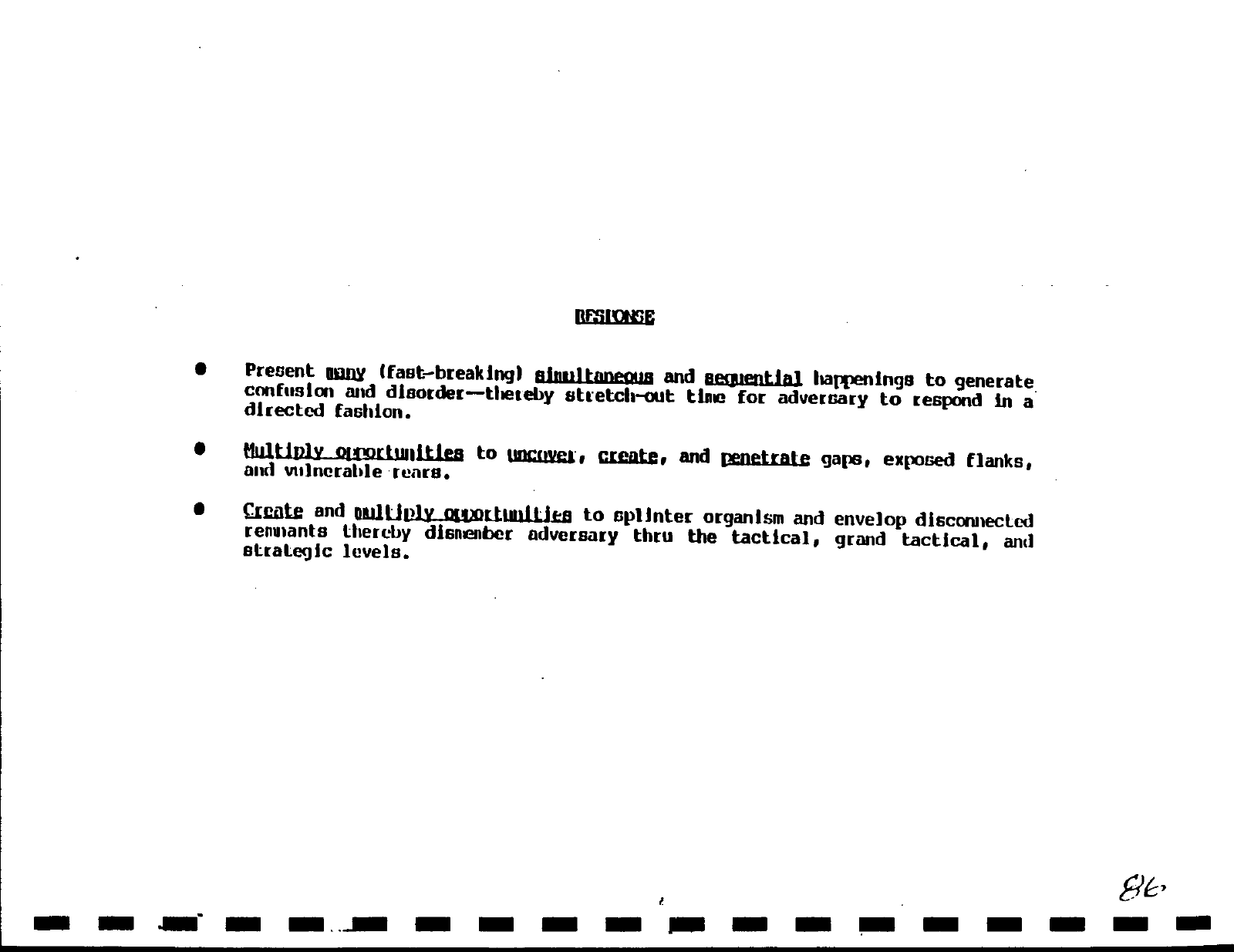
Historical pattern
18th-century theoreticians
- Saxe
- Bourcet
- Guibert
- Du Teil
Theme
- Plan with several branches
- Mobility/fluidity of force
- Cohesion
- Dispersion and concentration
- Operate on a line to threaten alternative objectives
- Concentrate direct artillery fire on key points to be forced
Action
- Napoleon was deeply influenced by the ideas of the above men. In early campaigns (as a general) he exploited these ideas of variety and rapidity with harmony for ambiguity, deception, and rapid/easy movement in order to surprise and successively defeat fractions of superior forces. In later campaigns (as emperor) he exchanged variety and harmony for rigid uniformity via massed direct artillery fire, dense infantry columns, and heavy cavalry going against regions of strong resistance—that resulted in an ever higher and crippling cost in casualties.
- American colonists, Spanish and Russian guerrillas exploited variety and rapidity associated with environmental background (terrain, weather, darkness, etc.) and mobility/fluidity of small bands with harmony of common cause against tyranny/injustice as basis to harass, confuse, and contribute toward the defeat of the British and French under Napoleon.
Slide 38
1986 PDF p.40 · Richards/Spinney p.39
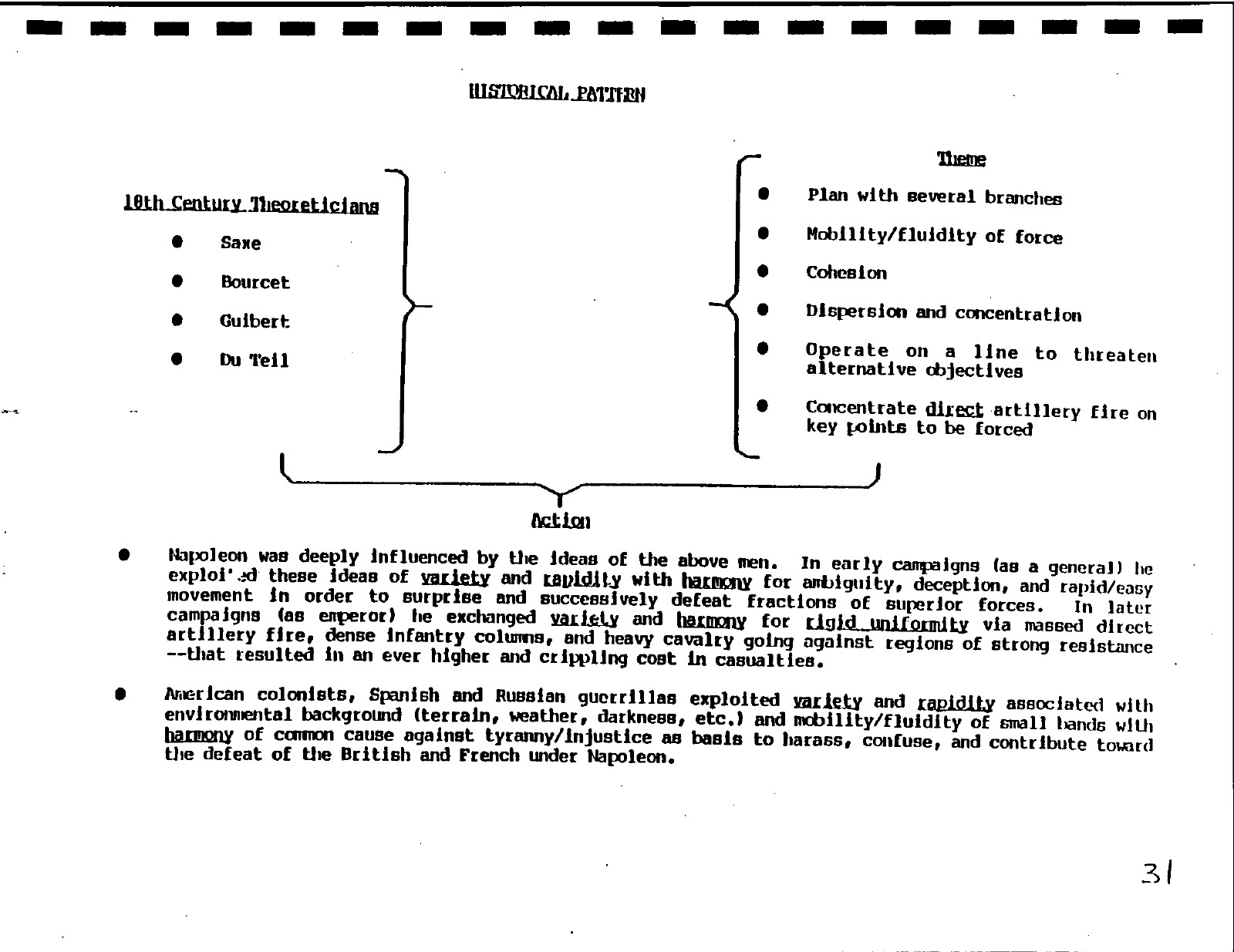
Historical pattern
Napoleon’s art of war
Critique
- Napoleon exploited ambiguity, deception, and mobility at the strategic level,
whereas,
- He increasingly emphasized formal battering ram methods and de-emphasized loose, irregular methods (e.g., skirmishers) at the tactical level—via a return to, and increasingly heavy-handed application of, the 1791 Drill Regulations.
Why?
- Napoleon emphasized the conduct of war from the top down. He created and exploited strategic success to procure grand tactical and tactical success.
- To support his concept he set up a highly centralized command and control system which, when coupled with essentially unvarying tactical recipes, resulted in strength smashing into strength by increasingly unimaginative, formalized and predictable actions at lower and lower levels.
Result
- Strategic maneuvers ambiguous and deceiving prior to tactical concentration; after concentration, “maneuvers” stereotyped and obvious.
hence
- Tactical “maneuvers” could not easily procure the victory because of their obvious, predictable nature.
Slide 68
1986 PDF p.70 · Richards/Spinney p.69
Soviet revolutionary strategy
(à la Lenin/Stalin)
Tasks
- Select “the moment for the decisive blow, the moment for starting the insurrection, so timed as to coincide with the moment when the crisis has reached its climax, when the vanguard is prepared to fight to the end, the reserves are prepared to support the vanguard, and maximum consternation reigns in the ranks of the enemy.” According to Lenin the decisive moment has arrived when:
- “All the class forces hostile to us have become sufficiently entangled, are sufficiently at loggerheads, have sufficiently weakened themselves in a struggle which is beyond their strength;”
- “All the vacillating, wavering, unstable, intermediate elements—the petty bourgeoisie, the petty-bourgeois democrats as distinct from the bourgeoisie—have sufficiently exposed themselves in the eyes of the people, have sufficiently disgraced themselves through their practical bankruptcy”
- “Among the proletariat a mass sentiment in favor of supporting the most determined, supremely bold, revolutionary action against the bourgeoisie has arisen and has begun to grow vigorously. Then revolution is indeed ripe. Then, indeed, if we have correctly gauged all the conditions indicated above…and if we have chosen the moment rightly, our victory is assured.”
- Pursue “the course adopted, no matter what difficulties and complications are encountered on the road towards the goal. This is necessary in order that the vanguard not lose sight of the main goal of the struggle and the masses not stray from the road while marching towards that goal and striving to rally around the vanguard.”
- Maneuver “the reserves with a view to effecting a proper retreat when the enemy is strong…when, with the given relation of forces, retreat becomes the only way to escape a blow against the vanguard and retain the vanguard’s reserves. The object of this strategy is to gain time, to disrupt the enemy, and to accumulate forces in order later to assume the offensive.”
Goal
- Destroy capitalism as well as its offspring imperialism and replace it with dictatorship of the proletariat.
Slide 85
1986 PDF p.87 · Richards/Spinney p.86
? — Natural question — ?
Why employ multiple thrusts, bundles of multiple thrusts, or bundles of thrusts inside bundles of thrusts?
85
Slide 86
1986 PDF p.88 · Richards/Spinney p.87
Response
- Present many (fast-breaking) simultaneous and sequential happenings to generate confusion and disorder—thereby stretch out time for adversary to respond in a directed fashion.
- Multiply opportunities to uncover, create, and penetrate gaps, exposed flanks, and vulnerable rears.
- Create and multiply opportunities to splinter organism and envelop disconnected remnants thereby dismember adversary thru the tactical, grand tactical, and strategic levels.