Slide source comparison

Sun Tzu · The Art of War

1986 original · PDF 15 · Matched Richards/Spinney revision · PDF 14
Unretouched 1986 full page 15

Sun Tzu · The Art of War

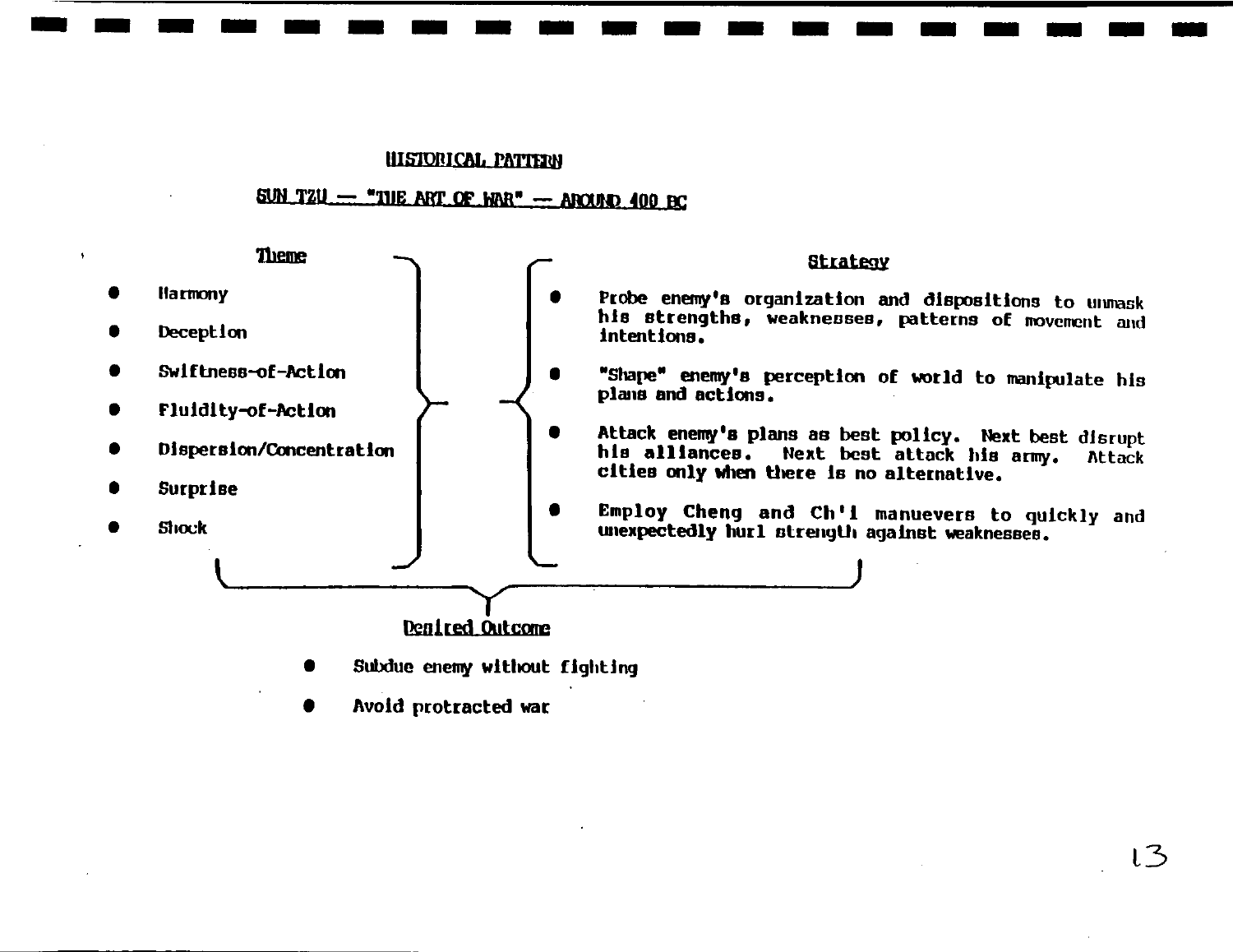
Historical pattern — Sun Tzu, The Art of War, around 400 BC; 1986 slide 13Seven original themes at left and four strategy statements at right, paired by facing braces. A single lower brace joins both columns to two desired outcomes. Original 1986 themes, not the expanded 1991 theme pairs shown in the video. Historical patternSun Tzu · The Art of War · around 400 BCThemeStrategyHarmonyDeceptionSwiftness-of-ActionFluidity-of-ActionDispersion/ConcentrationSurpriseShockProbe enemy’s organization anddispositions to unmask his strengths,weaknesses, patterns of movement andintentions.“Shape” enemy’s perception of world tomanipulate his plans and actions.Attack enemy’s plans as best policy. Nextbest disrupt his alliances. Next bestattack his army. Attack cities only whenthere is no alternative.Employ Cheng and Ch’i maneuvers to quicklyand unexpectedly hurl strength againstweaknesses.Desired outcome• Subdue enemy without fighting• Avoid protracted war13
Later wording shown in the video

The video uses the later theme pairs: harmony and trust; justice and well being; inscrutability and enigma; deception and subversion; rapidity and fluidity; dispersion and concentration; surprise and shock. The 1986 chart above keeps the original seven themes. Richards/Spinney dates the revision JRB 1/1991.

13

Early commanders

1986 original · PDF 16 · Matched Richards/Spinney revision · PDF 15
Unretouched 1986 full page 16

Early commanders

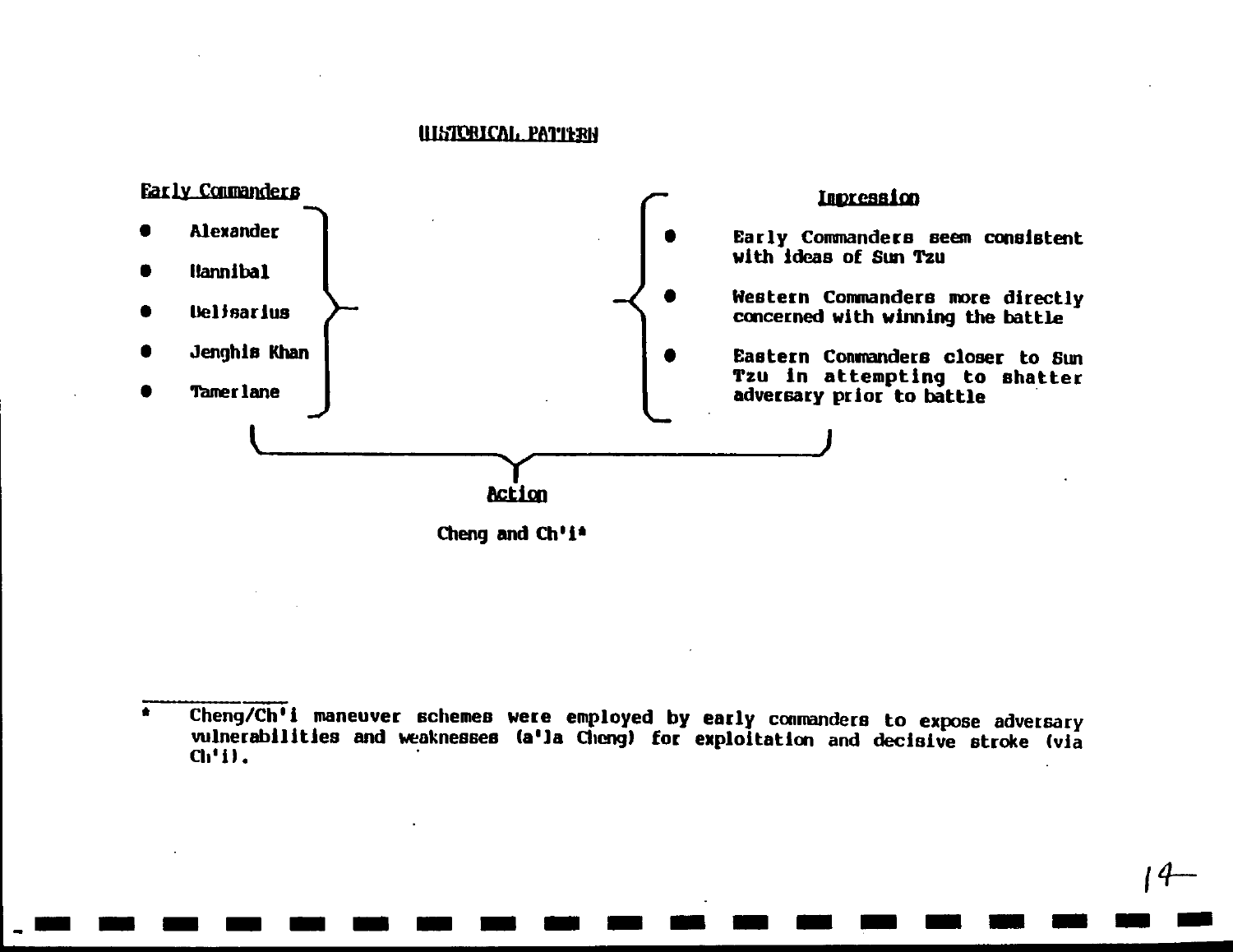
Early commanders — 1986 association chartTwo columns connected by facing braces, with a shared lower brace leading to Action — Cheng and Ch’i*. Association, not directional movement.Early commandersImpression• Alexander• Hannibal• Belisarius• Jenghis Khan• Tamerlane• Early commanders seem consistent withideas of Sun Tzu• Western commanders more directlyconcerned with winning the battle• Eastern commanders closer to Sun Tzuin attempting to shatter adversary priorto battleAction — Cheng and Ch’i** Cheng/Ch’i maneuver schemes were employed by early commanders to expose adversaryvulnerabilities and weaknesses (a’la Cheng) for exploitation and decisive stroke(via Ch’i).
14

From tactics to battles

1986 original · PDF 17 · Matched Richards/Spinney revision · PDF 16
Unretouched 1986 full page 17

From tactics to battles

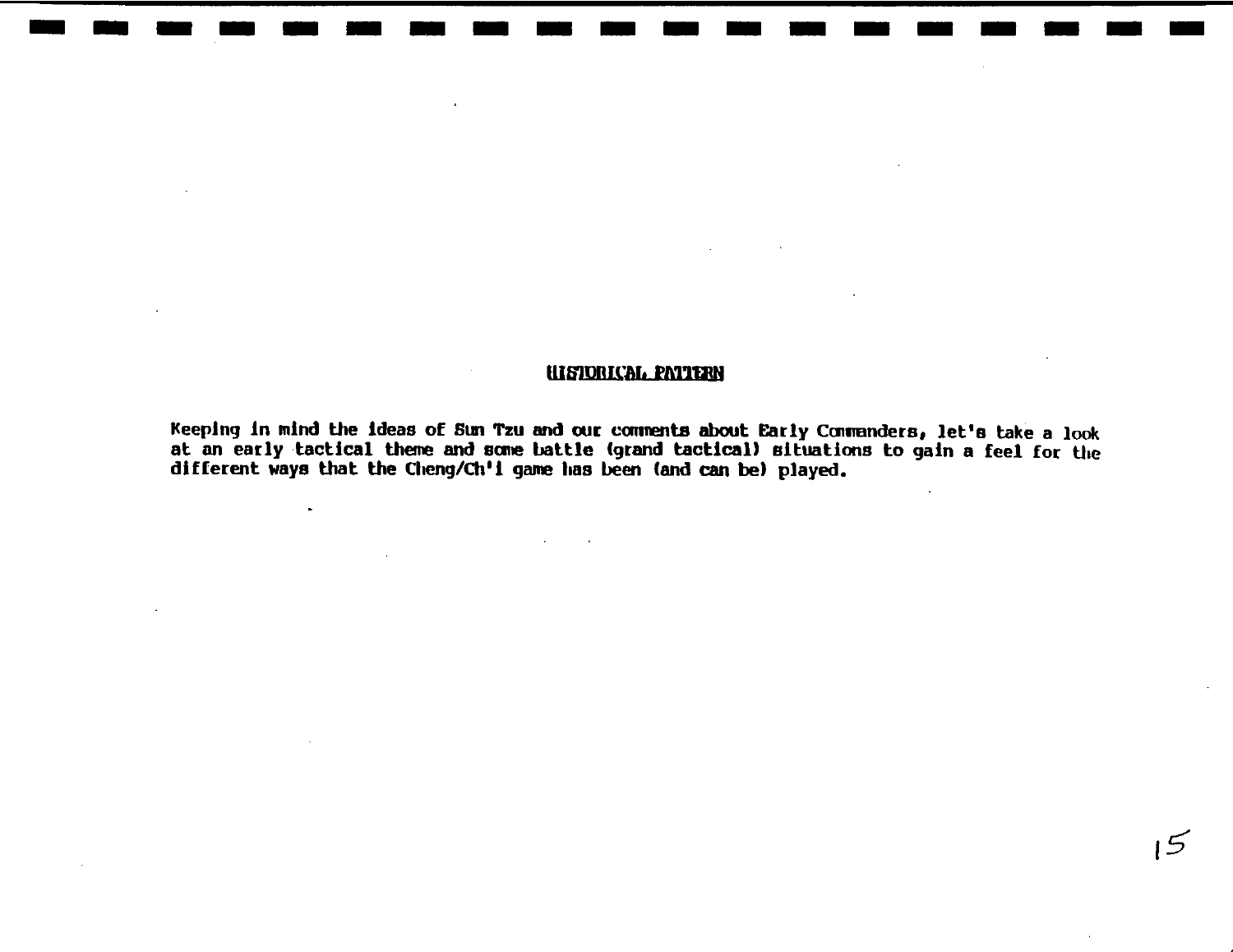
Keeping in mind the ideas of Sun Tzu and our comments about early commanders, let’s take a look at an early tactical theme and some battle (grand tactical) situations to gain a feel for the different ways that the Cheng/Ch’i game has been (and can be) played.

15

Light and heavy troops

1986 original · PDF 18 · Matched Richards/Spinney revision · PDF 17
Unretouched 1986 full page 18

Light and heavy troops

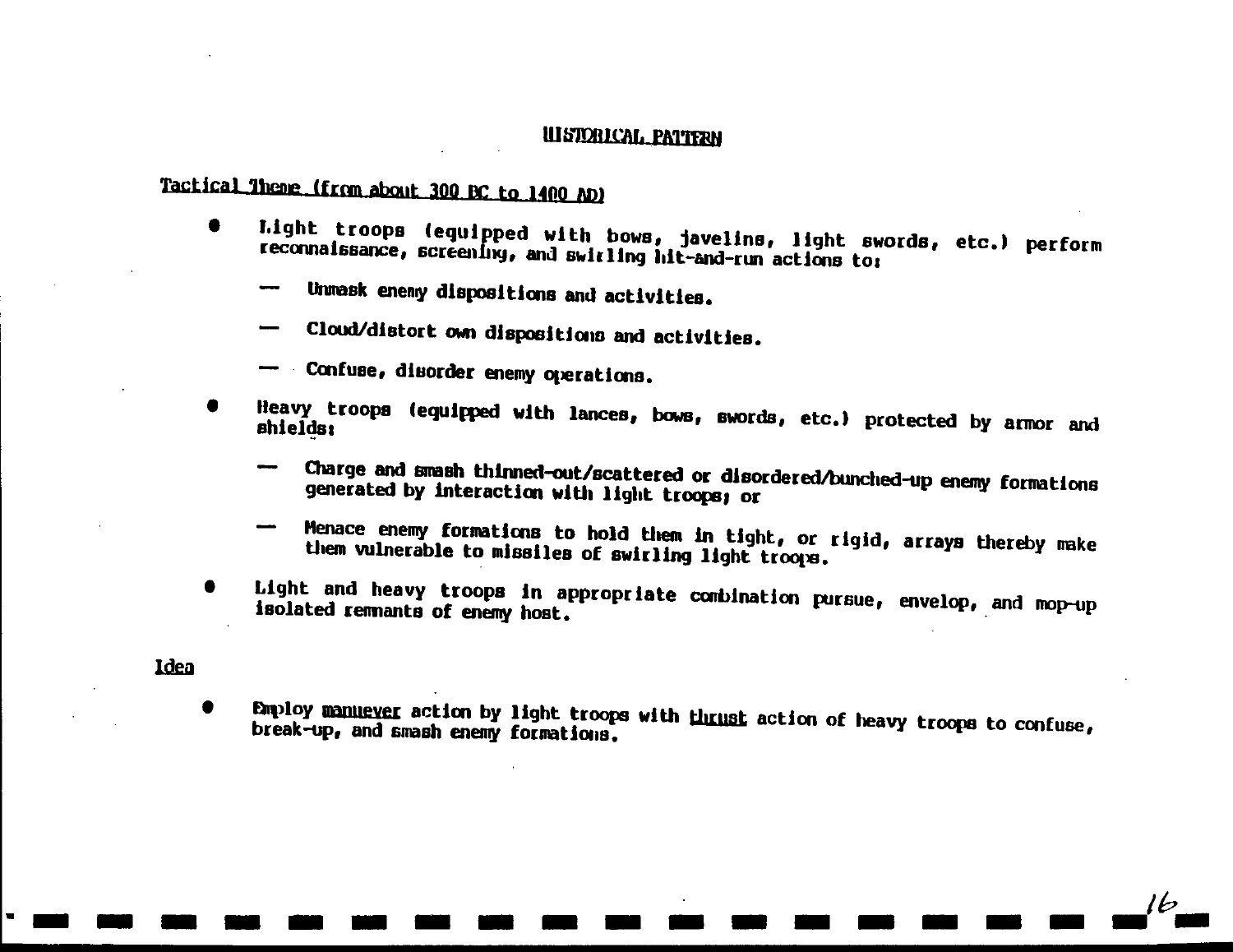
Tactical theme · about 300 BC to 1400 AD

  • Light troops (equipped with bows, javelins, light swords, etc.) perform reconnaissance, screening, and swirling hit-and-run actions to:
    • Unmask enemy dispositions and activities.
    • Cloud/distort own dispositions and activities.
    • Confuse, disorder enemy operations.
  • Heavy troops (equipped with lances, bows, swords, etc.) protected by armor and shields:
    • Charge and smash thinned-out/scattered or disordered/bunched-up enemy formations generated by interaction with light troops; or
    • Menace enemy formations to hold them in tight, or rigid, arrays thereby make them vulnerable to missiles of swirling light troops.
  • Light and heavy troops in appropriate combination pursue, envelop, and mop up isolated remnants of enemy host.

Idea

Employ maneuver action by light troops with thrust action of heavy troops to confuse, break up, and smash enemy formations.

16

Battle of Marathon · 490 BC

1986 original · PDF 19 · Matched Richards/Spinney revision · PDF 18
Unretouched 1986 full page 19

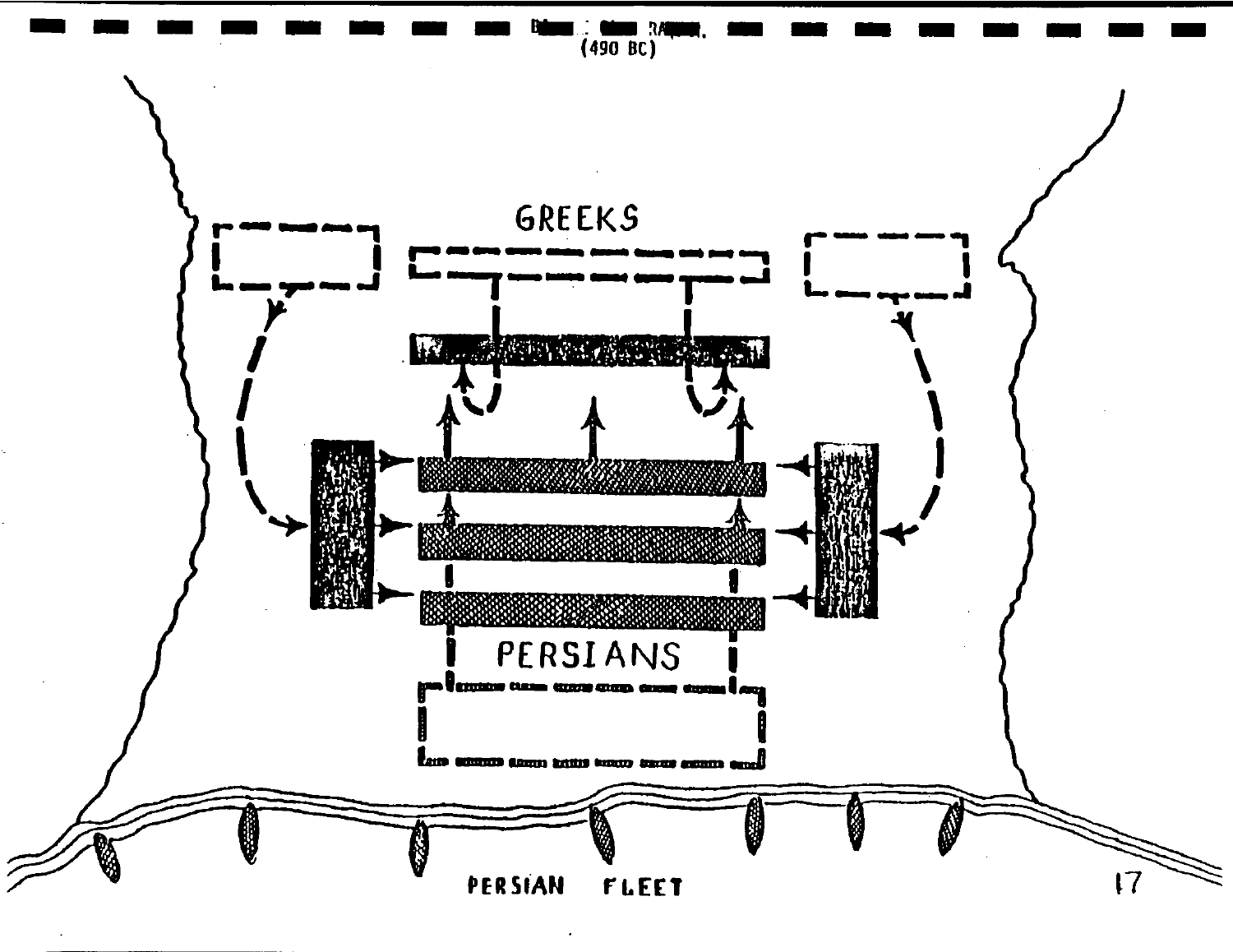
Battle of Marathon · 490 BC

Battle of Marathon, 490 BC — reconstruction Greek positions above the Persian ranks, with dashed earlier positions and curved movements around both flanks. Three Persian ranks face upward; solid Greek flank blocks have inward arrows. Seven fleet symbols follow the coast below. Not a troop-strength scale. Greeks Persians Persian fleet
17

Battle of Leuctra · 371 BC

1986 original · PDF 20 · Matched Richards/Spinney revision · PDF 19
Unretouched 1986 full page 20

Battle of Leuctra · 371 BC

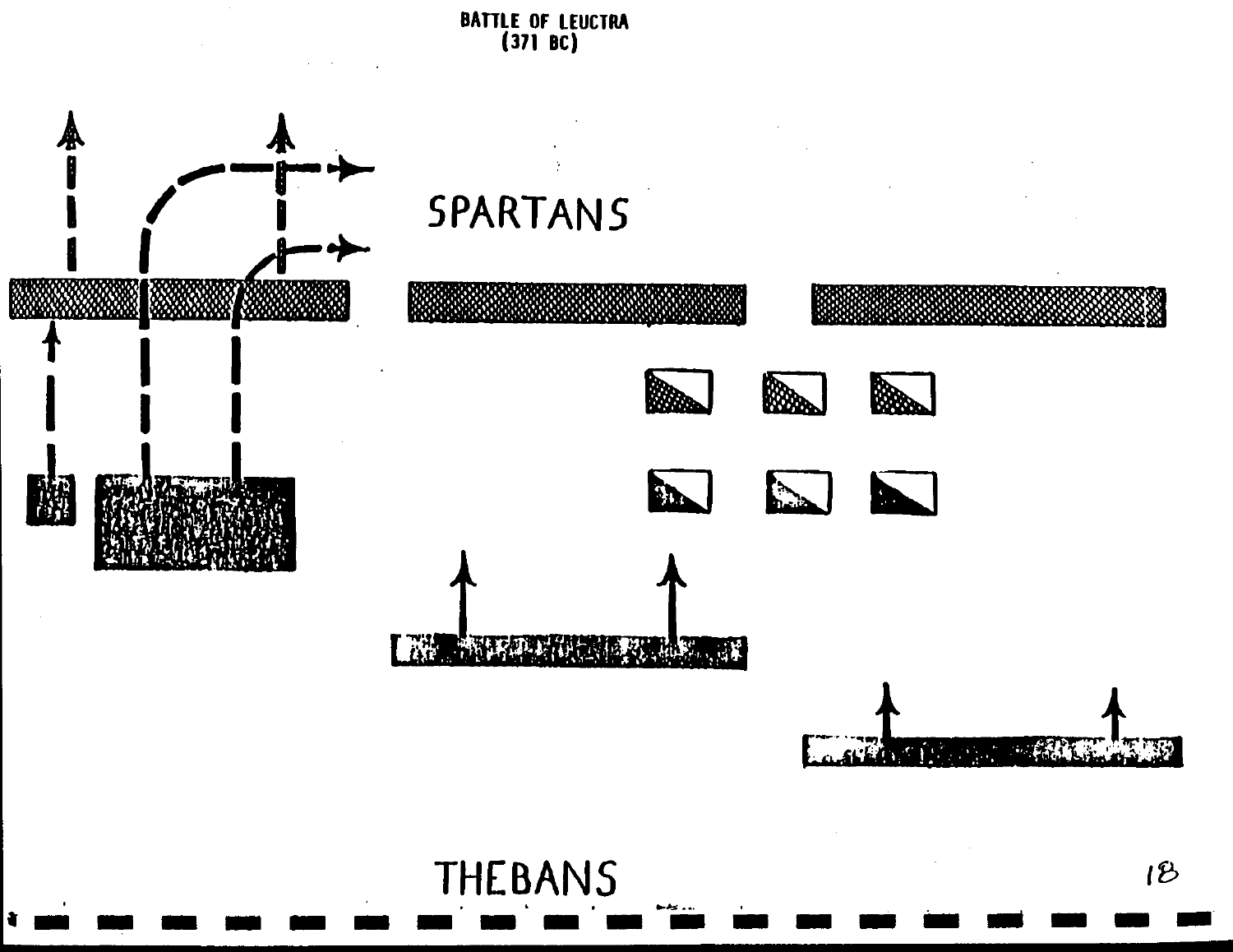
Battle of Leuctra, reconstructed from the 1986 drawing Three hatched Spartan bars extend across the upper field. The Theban formations below are staggered, with a deep block on the left and two thinner bars farther back to the right. Solid upward arrows accompany the lower bars; dashed paths on the left pass through the Spartan line and turn right. Six diagonally divided rectangles are retained at center-right without assigning them an inferred unit type. Block sizes and paths are approximate redrawings, not a troop-strength scale. Spartans Thebans
18

Savkin on Leuctra

1986 original · PDF 21 · Matched Richards/Spinney revision · PDF 20
Unretouched 1986 full page 21

Savkin on Leuctra

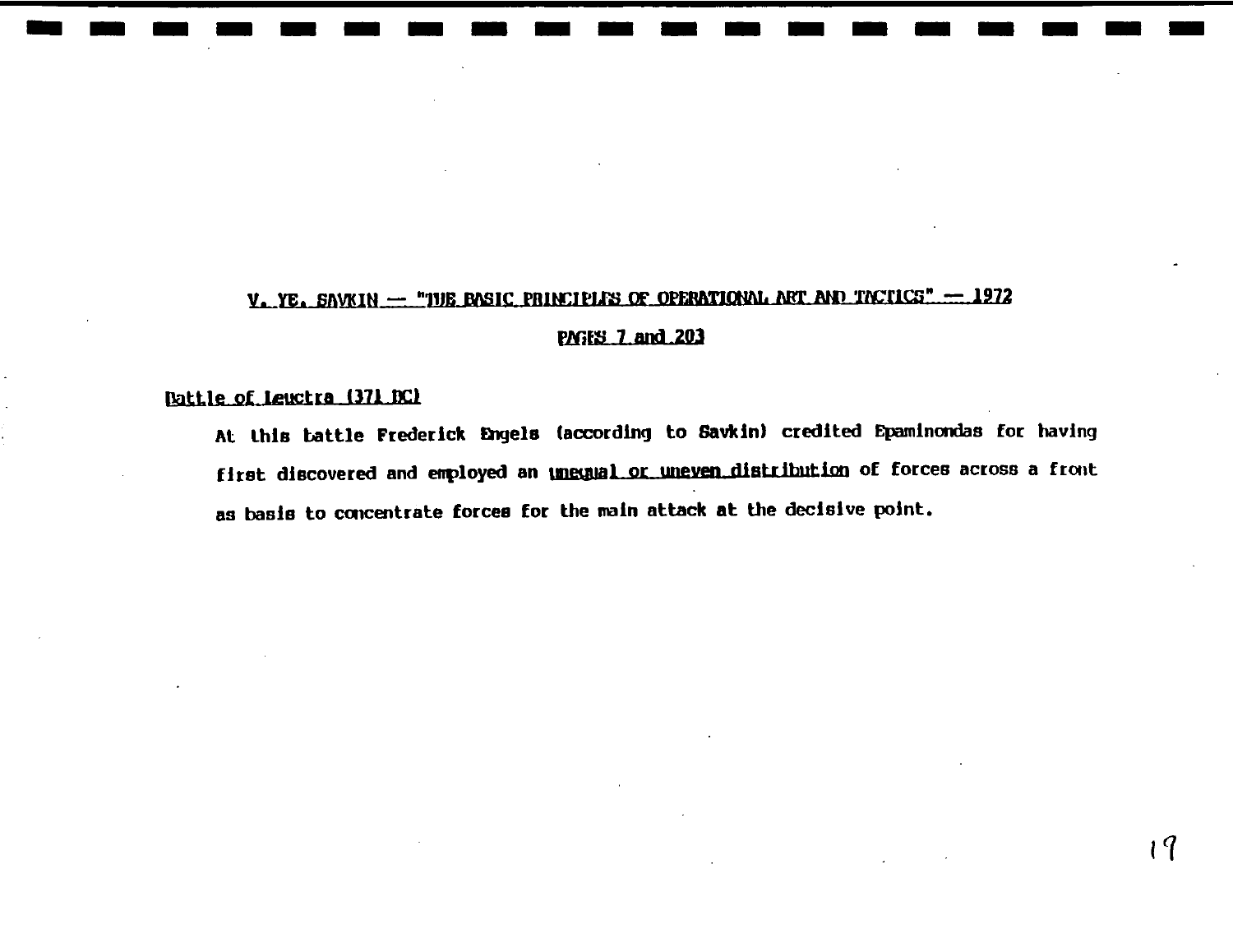
V. Ye. Savkin
The Basic Principles of Operational Art and Tactics (1972), pages 7 and 203.

Battle of Leuctra · 371 BC

At this battle Frederick Engels (according to Savkin) credited Epaminondas for having first discovered and employed an unequal or uneven distribution of forces across a front as basis to concentrate forces for the main attack at the decisive point.

19

Battle of Arbela · 331 BC

1986 original · PDF 22 · Matched Richards/Spinney revision · PDF 21
Unretouched 1986 full page 22

Battle of Arbela · 331 BC

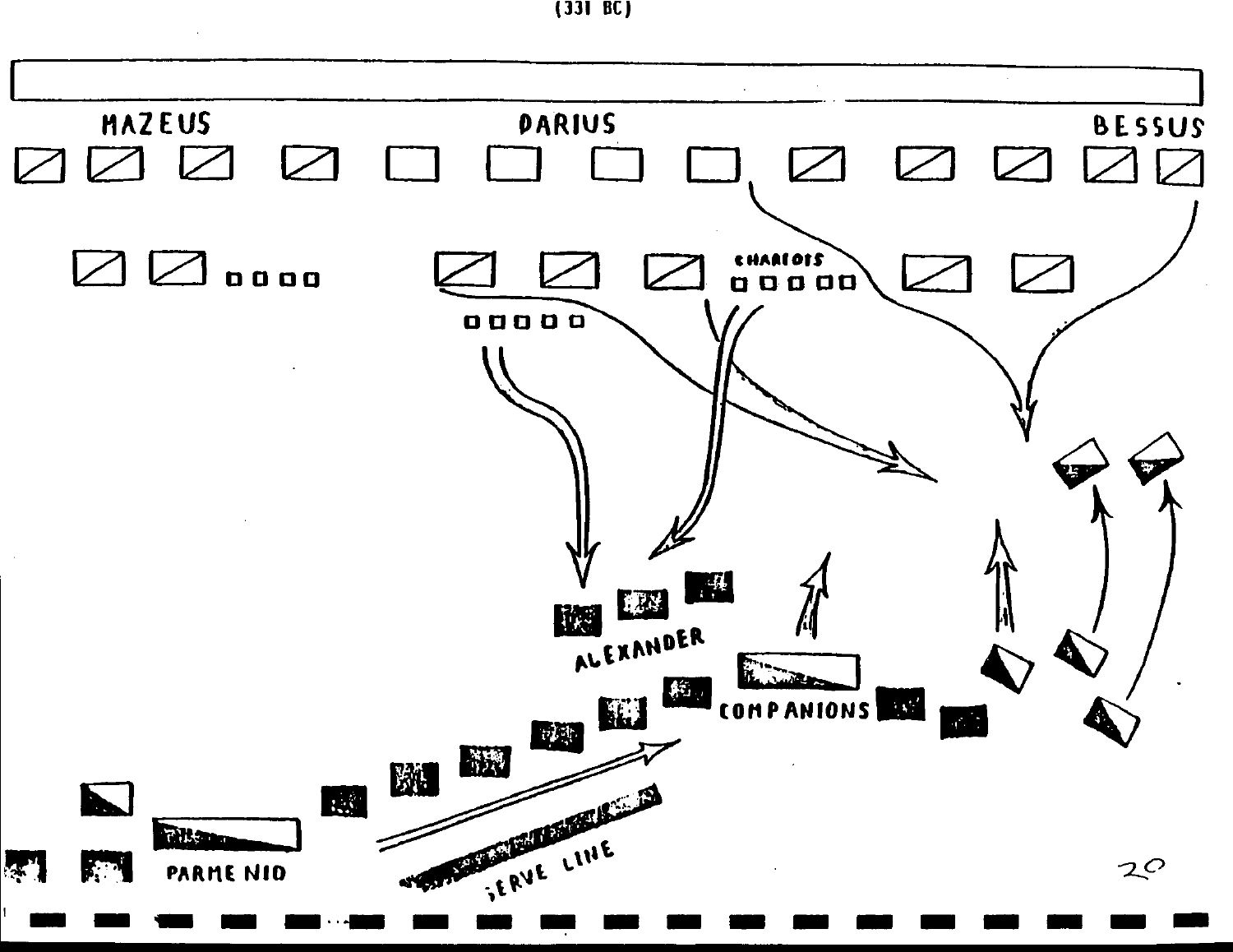
Battle of Arbela, 331 BC — openingThirteen front Persian blocks, seven rear blocks and three groups of small chariot symbols face Alexander's staggered formations. Nine arrow tips retain the source's hollow thrusts, outlined converging paths and finer upward strokes; the lower reserve line advances diagonally. Plum is editorial, not a unit-allegiance key. Open and divided blocks retain the source distinctions; proportions are not troop counts. MazeusDariusBessus Chariots AlexanderCompanionsParmenioReserve line
20

Arbela · Phase II

1986 original · PDF 23 · Matched Richards/Spinney revision · PDF 22
Unretouched 1986 full page 23

Arbela · Phase II

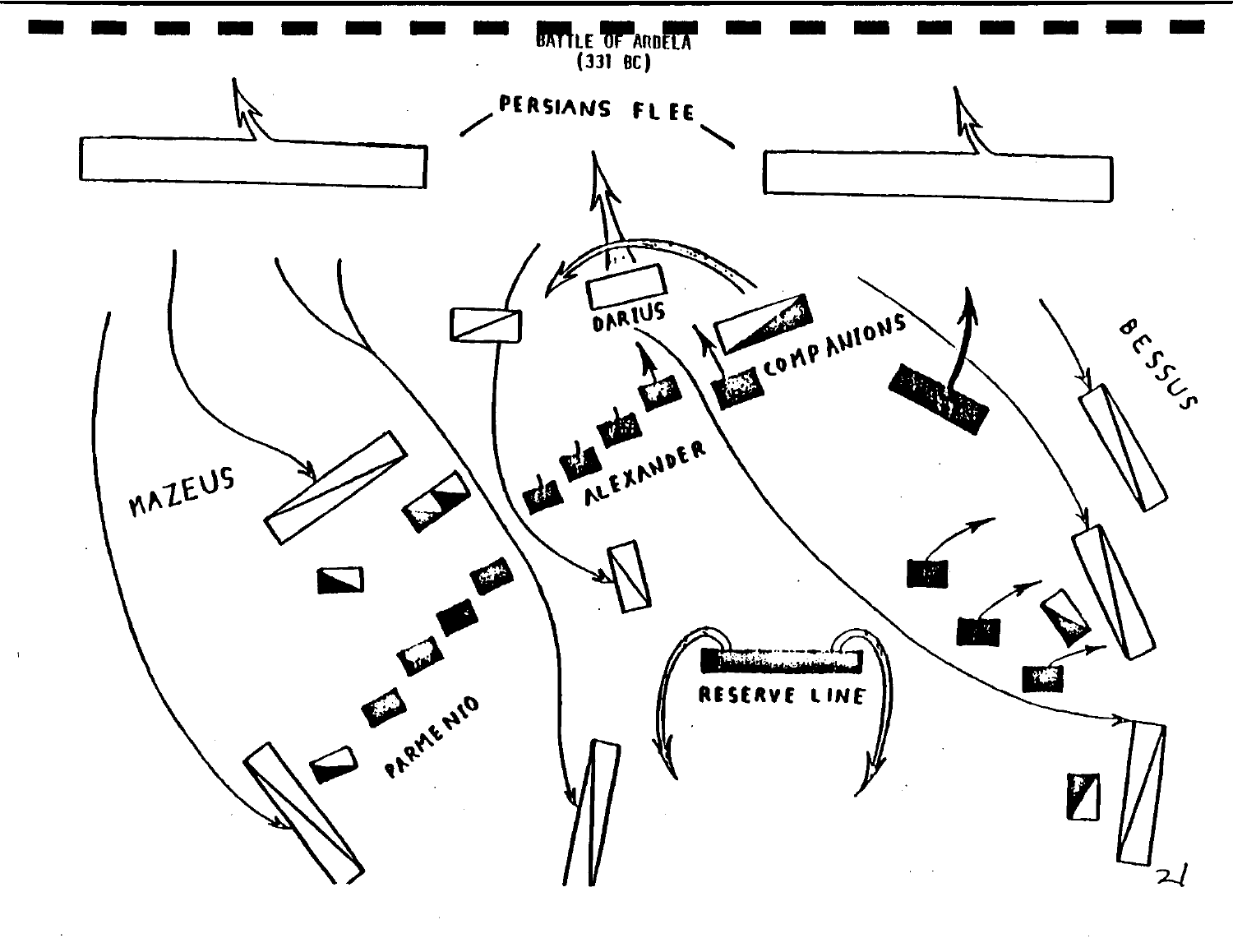
Battle of Arbela, 331 BC — Phase II1986 page 23: two upper Persian lines flee upward. Alexander's oblique advance turns toward Darius. Mazeus and Bessus movements pass around the flanks, while both reserve-line ends turn downward. Open, divided and solid formations are distinguished. Outlined flight, encircling and reserve movements remain distinct from fine retreat routes and solid thrusts. Color is editorial, not an allegiance key. Not a calibrated battlefield map. Persians flee DariusCompanionsAlexanderParmenioReserve lineMazeusBessus
21

Cannae · opening phase · 216 BC

1986 original · PDF 24 · Matched Richards/Spinney revision · PDF 23
Unretouched 1986 full page 24

Cannae · opening phase · 216 BC

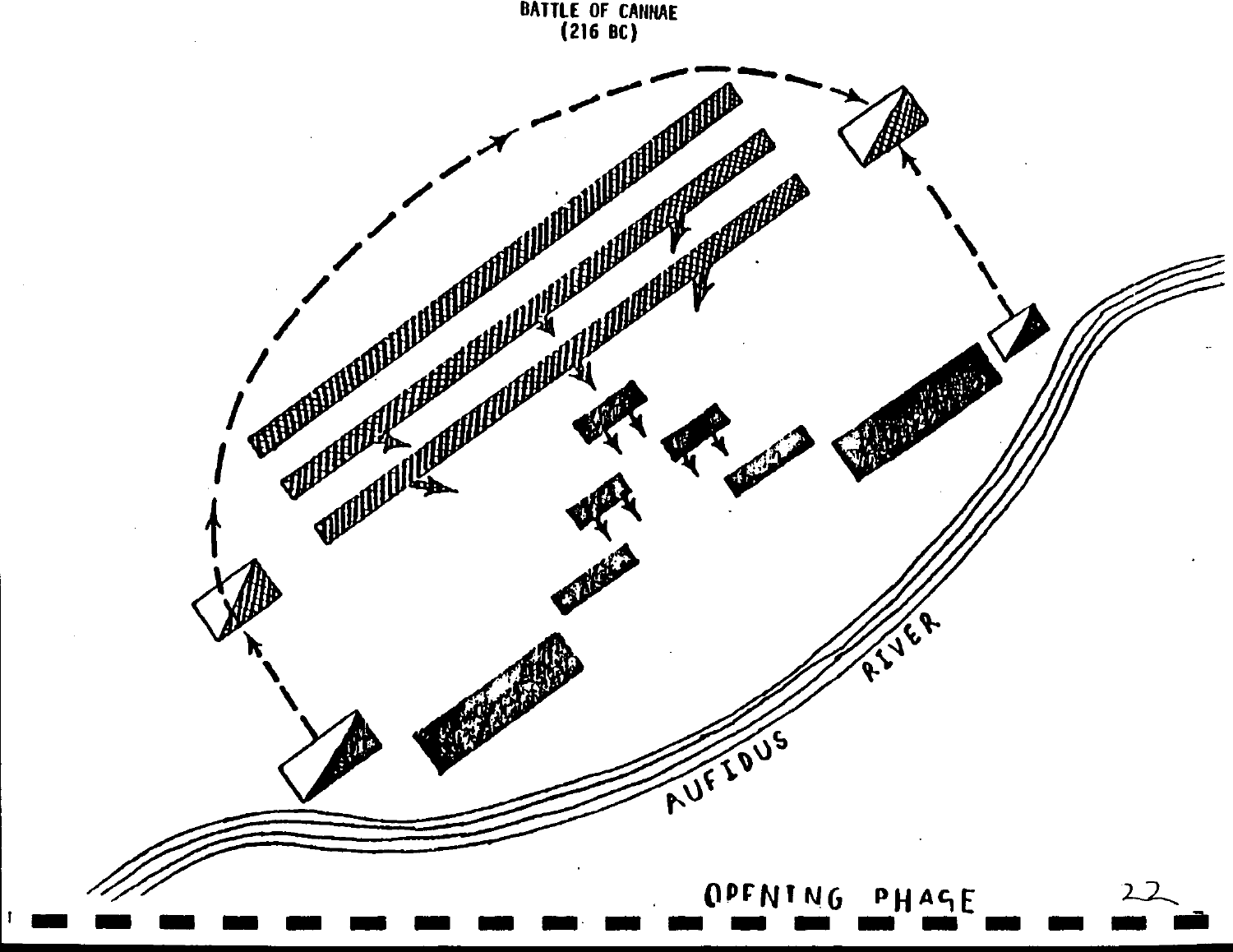
Battle of Cannae, 216 BC — opening phase reconstruction Three parallel diagonal ranks face a broken opposing formation beside the Aufidus River. Four diagonally divided symbols occupy positions at either end. Dashed movements connect them, including the long arc over the upper ranks. Unit identities are unspecified. Aufidus River Opening phase
22

Cannae · final phase

1986 original · PDF 25 · Matched Richards/Spinney revision · PDF 24
Unretouched 1986 full page 25

Cannae · final phase

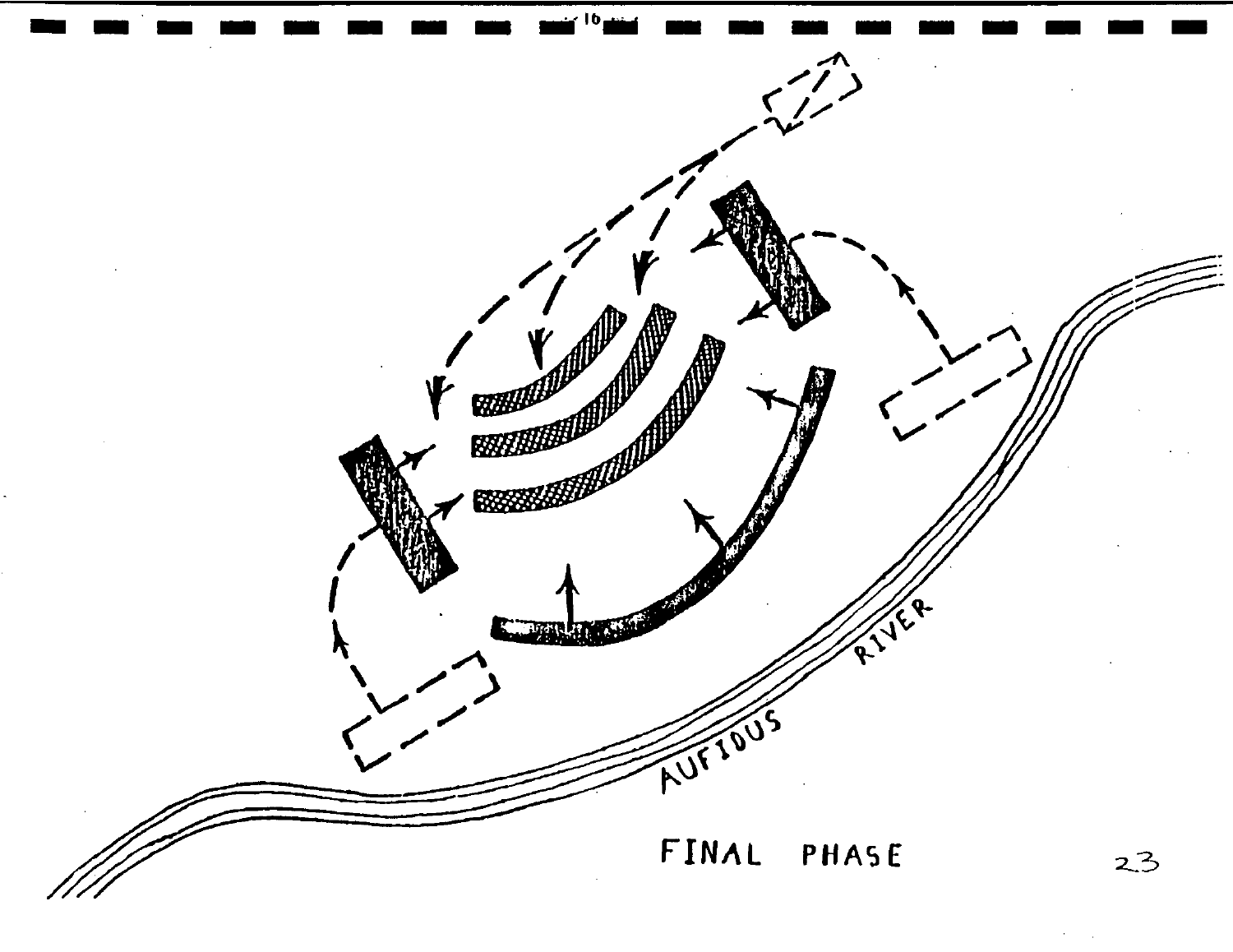
Battle of Cannae — final phase reconstruction The three parallel ranks of the opening phase are now curved. A larger curved formation and two side blocks surround them on three sides. Dashed former positions and movement arcs lie outside the formations. The Aufidus River curves below and to the right. The drawing is a schematic reconstruction, not a measured battle map. Aufidus River Final phase
23

Impression

1986 original · PDF 26 · Matched Richards/Spinney revision · PDF 25
Unretouched 1986 full page 26

Impression

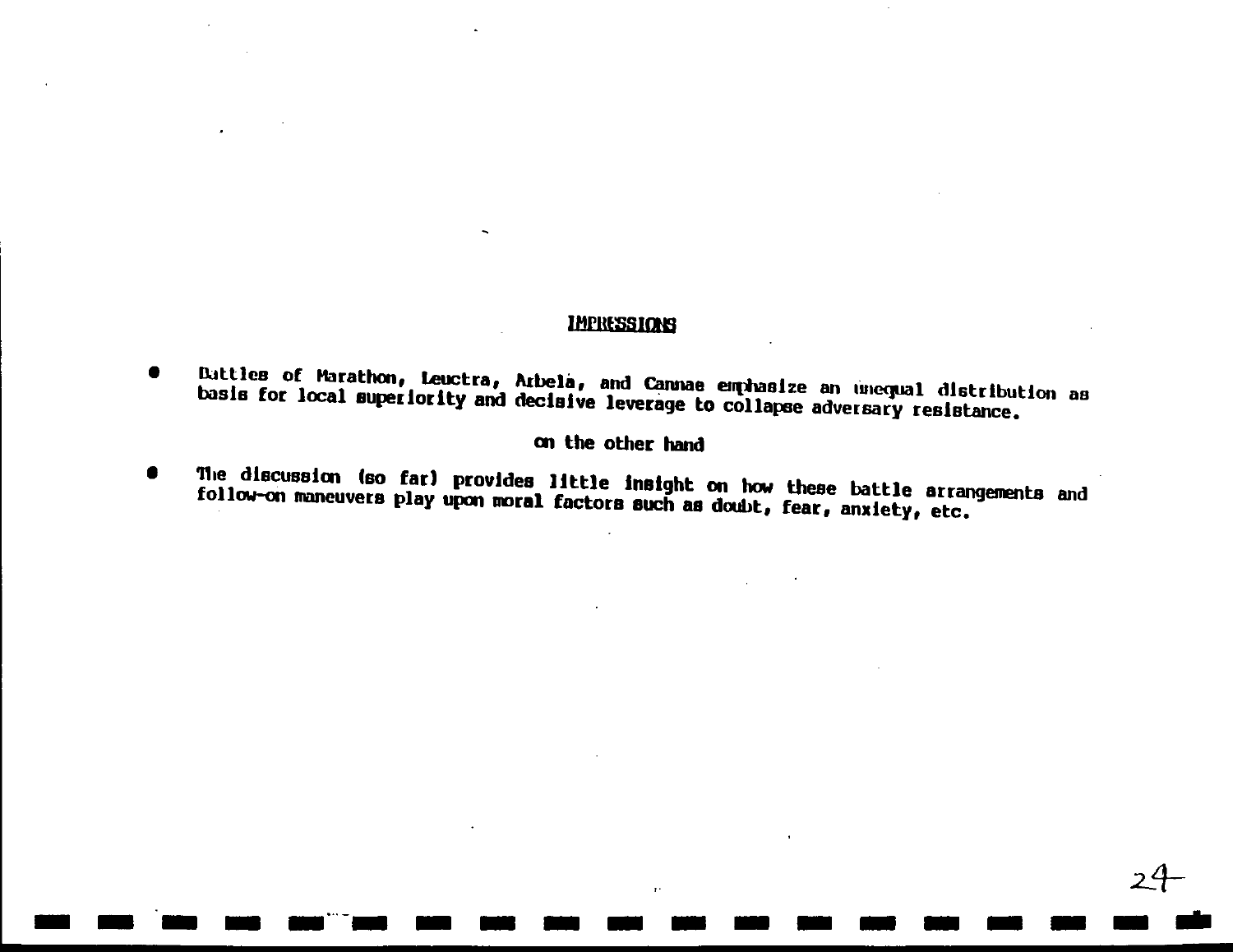
Battles of Marathon, Leuctra, Arbela, and Cannae emphasize an unequal distribution as basis for local superiority and decisive leverage to collapse adversary resistance.

On the other hand

The discussion (so far) provides little insight on how these battle arrangements and follow-on maneuvers play upon moral factors such as doubt, fear, anxiety, etc.

24

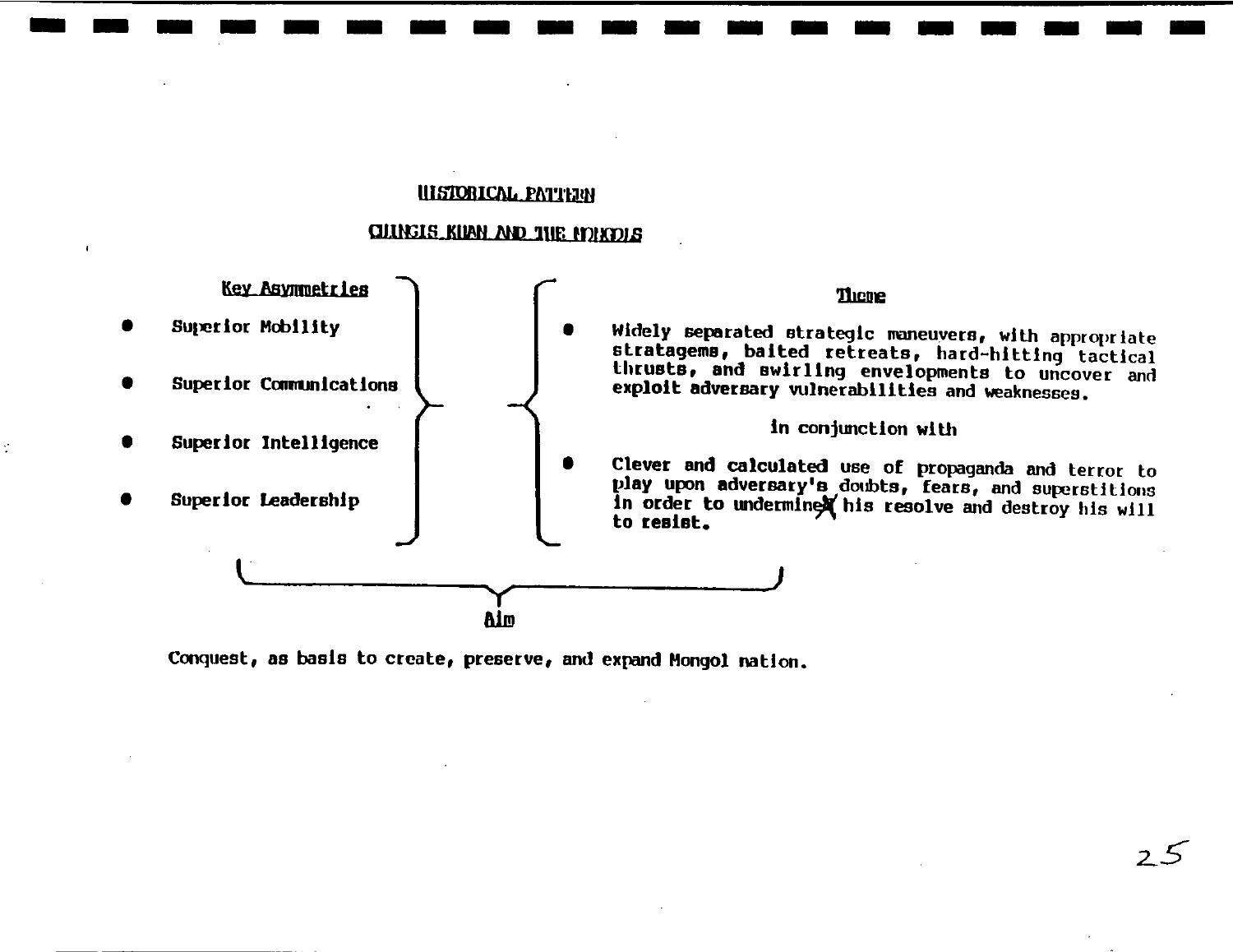
Chingis Khan and the Mongols

1986 original · PDF 27 · Matched Richards/Spinney revision · PDF 26
Unretouched 1986 full page 27

Chingis Khan and the Mongols

Chingis Khan and the Mongols — 1986 association chartTwo columns connected by facing braces, with a shared lower brace leading to Aim. Association, not directional movement.Key asymmetriesTheme• Superior mobility• Superior communications• Superior intelligence• Superior leadership• Widely separated strategic maneuvers,with appropriate stratagems, baitedretreats, hard-hitting tactical thrusts,and swirling envelopments to uncover andexploit adversary vulnerabilities andweaknesses.In conjunction with• Clever and calculated use ofpropaganda and terror to play uponadversary’s doubts, fears, andsuperstitions in order to undermine hisresolve and destroy his will to resist.AimConquest, as basis to create, preserve, and expand Mongol nation.
25

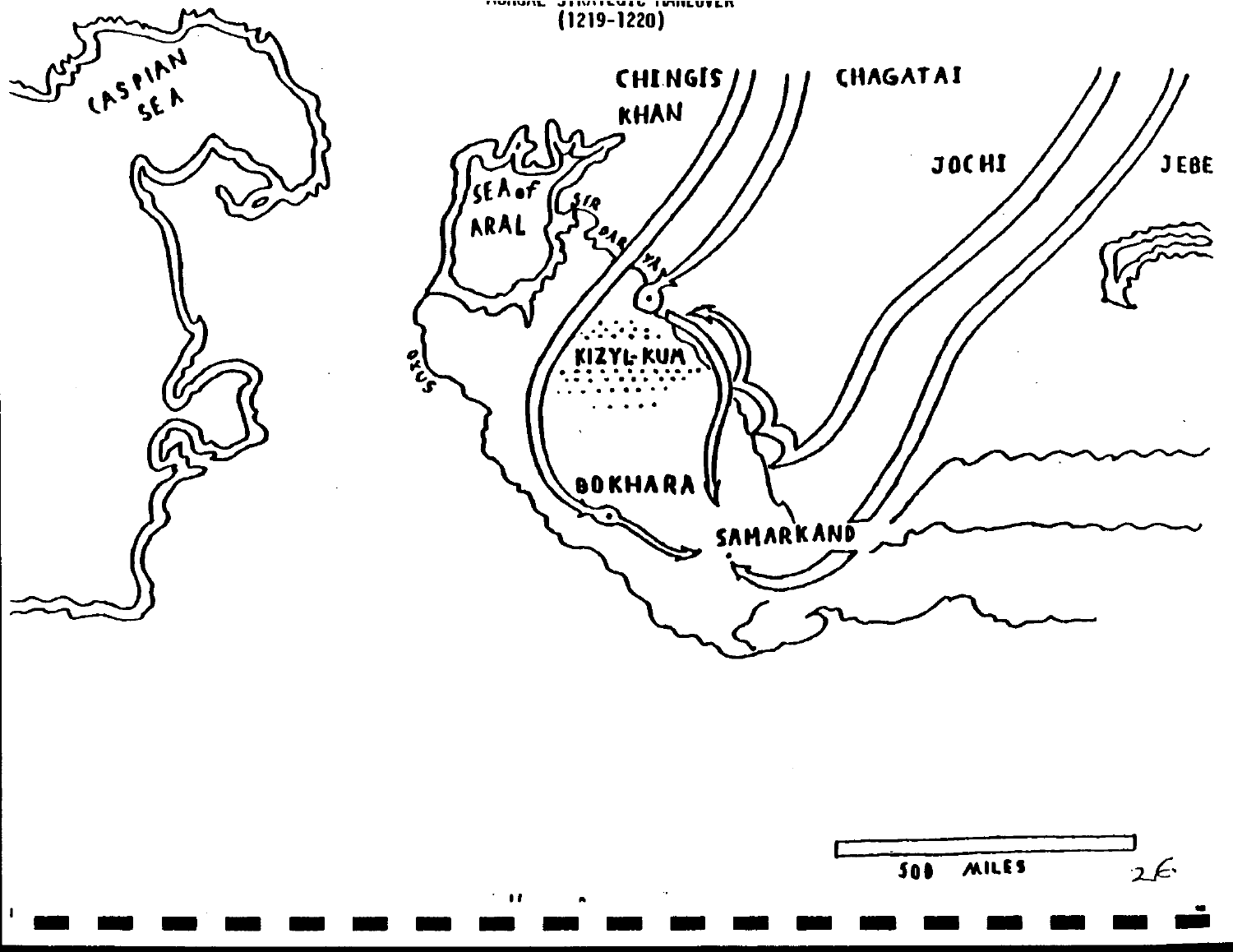
Mongol strategic maneuver · 1219–1220

1986 original · PDF 28 · Matched Richards/Spinney revision · PDF 27
Unretouched 1986 full page 28

Mongol strategic maneuver · 1219–1220

Mongol strategic maneuver, 1219–1220Caspian Sea to the left, Sea of Aral above the Oxus and Sir Darya rivers; Kizyl-Kum dotted desert between. Four named approach routes: Chingis Khan past Bokhara, Chagatai toward the upper river junction, Jochi with branching routes, and Jebe curving to Samarkand. A 500-mile source scale is reproduced but is not a measurement tool for this uncalibrated drawing. Caspian SeaSea ofAralChingisKhanChagataiJochiJebeKizyl-KumBokharaSamarkandOxusSir Darya 500 miles
26

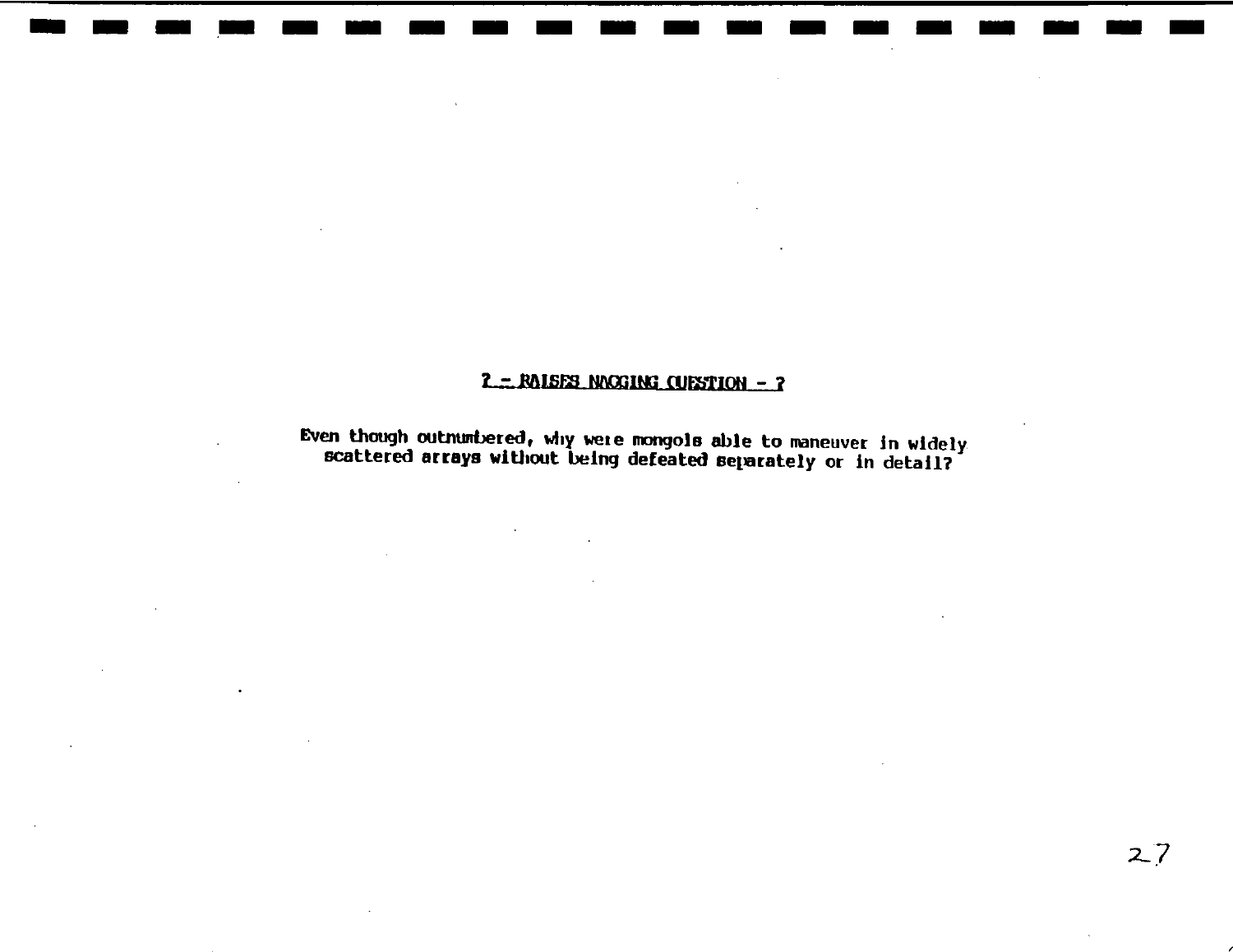
A nagging question

1986 original · PDF 29 · Matched Richards/Spinney revision · PDF 28
Unretouched 1986 full page 29

A nagging question

Even though outnumbered, why were Mongols able to maneuver in widely scattered arrays without being defeated separately or in detail?

27

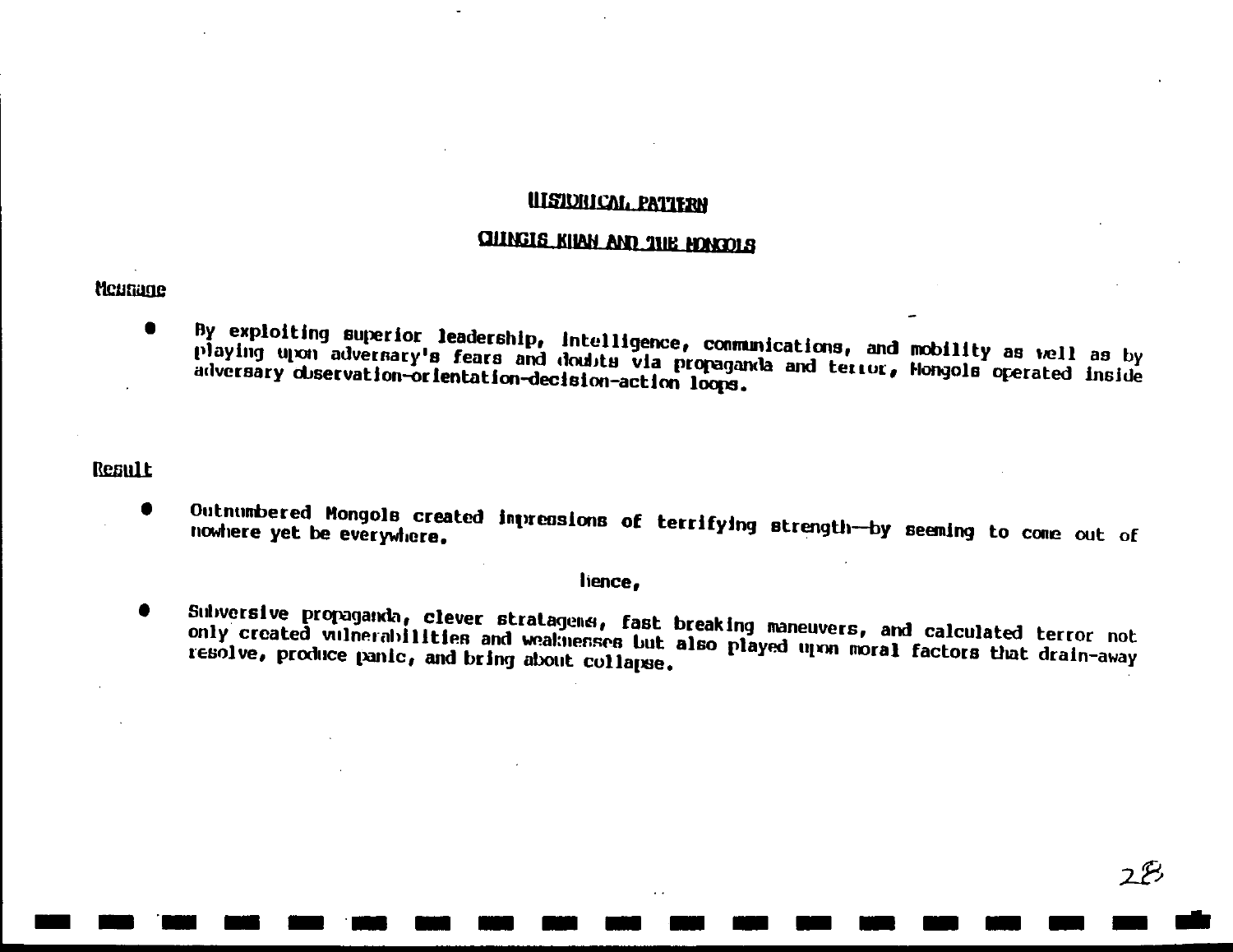
Mongol message and result

1986 original · PDF 30 · Matched Richards/Spinney revision · PDF 29
Unretouched 1986 full page 30

Mongol message and result

Message

By exploiting superior leadership, intelligence, communications, and mobility as well as by playing upon adversary’s fears and doubts via propaganda and terror, Mongols operated inside adversary observation-orientation-decision-action loops.

Result

Outnumbered Mongols created impressions of terrifying strength—by seeming to come out of nowhere yet be everywhere.

Hence

Subversive propaganda, clever stratagems, fast breaking maneuvers, and calculated terror not only created vulnerabilities and weaknesses but also played upon moral factors that drain away resolve, produce panic, and bring about collapse.

28

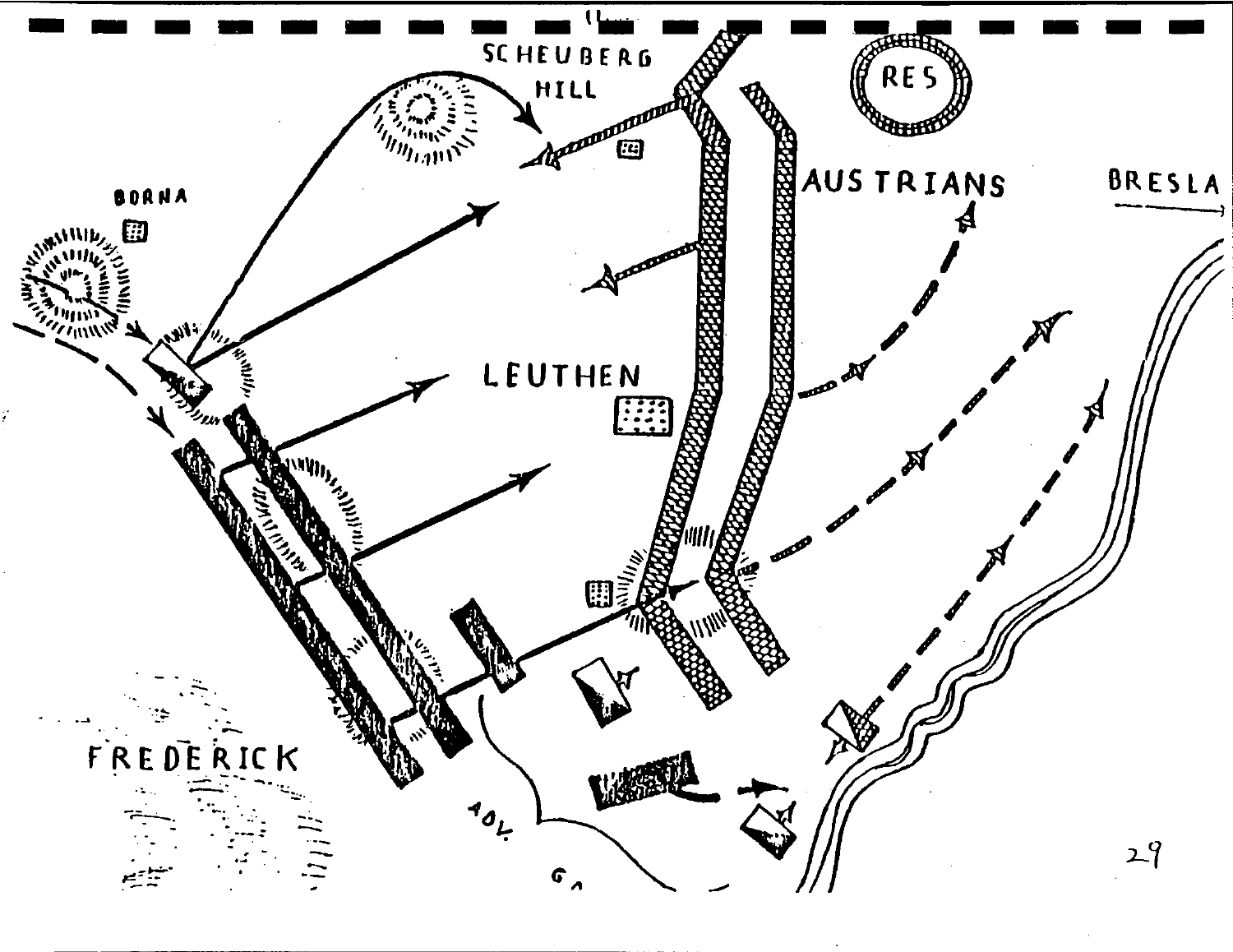
Battle of Leuthen

1986 original · PDF 31 · Matched Richards/Spinney revision · PDF 30
Unretouched 1986 full page 31

Battle of Leuthen

Battle of Leuthen — 1986 source reconstructionFrederick's two oblique formations at lower left oppose two bent Austrian lines. Four solid advance arrows, one upper enveloping movement, two short Austrian thrusts, three dashed withdrawal routes and an advance-guard arrow are retained. Hill rings, settlement blocks, reserve circle and the right-hand river follow the original scan. BornaScheubergHillLeuthenAustriansRes.BreslauFrederickAdvance guard
29

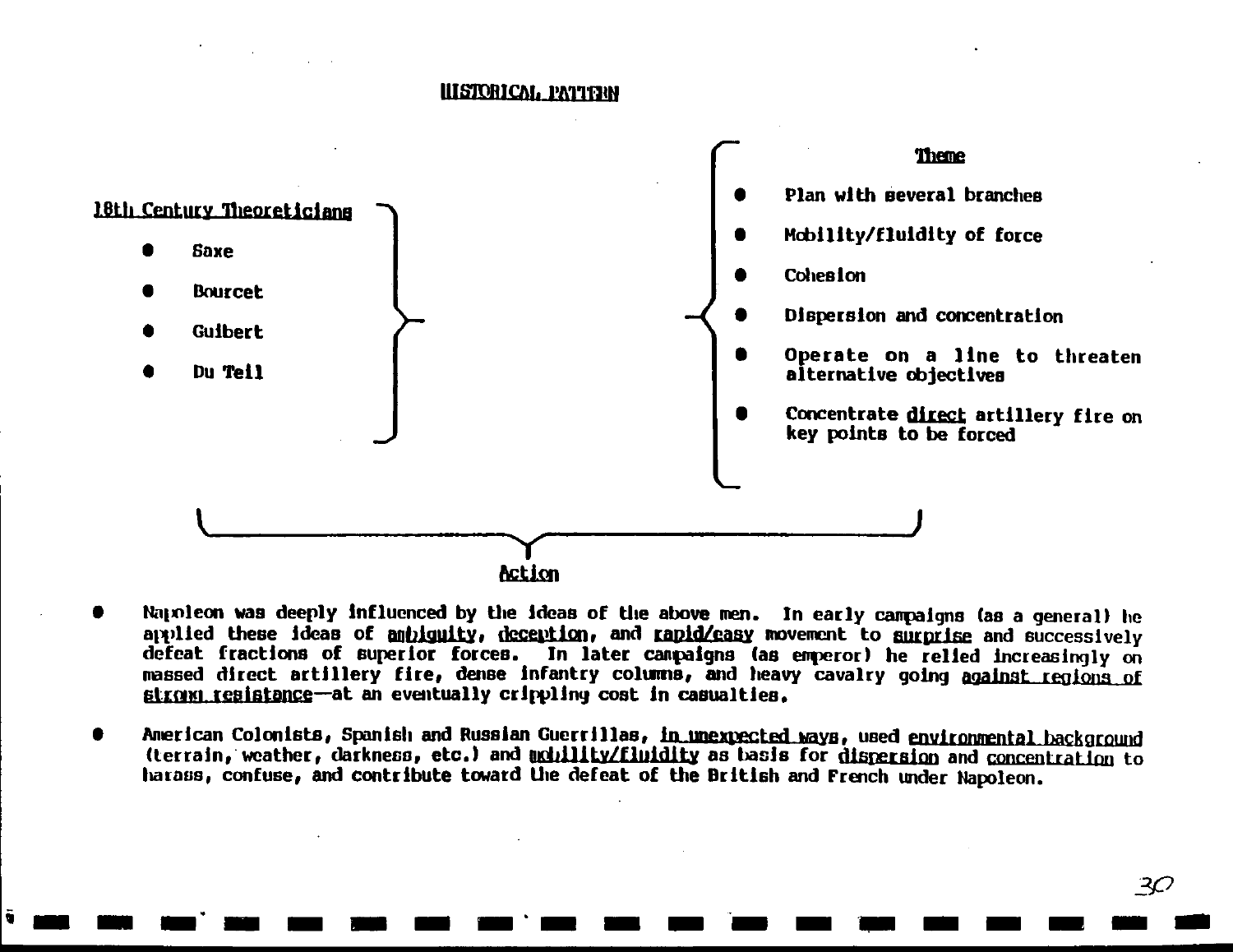
18th-century theoreticians

1986 original · PDF 32 · Matched Richards/Spinney revision · PDF 31
Unretouched 1986 full page 32

18th-century theoreticians

18th-century theoreticians — 1986 association chartTwo columns connected by facing braces, with a shared lower brace leading to Action. Association, not directional movement.18th-century theoreticiansTheme• Saxe• Bourcet• Guibert• Du Teil• Plan with several branches• Mobility/fluidity of force• Cohesion• Dispersion and concentration• Operate on a line to threatenalternative objectives• Concentrate direct artillery fire onkey points to be forcedActionNapoleon was deeply influenced by the ideas of the above men. In early campaigns(as a general) he applied these ideas of ambiguity, deception, and rapid/easymovement to surprise and successively defeat fractions of superior forces. In latercampaigns (as emperor) he relied increasingly on massed direct artillery fire,dense infantry columns, and heavy cavalry going against regions of strongresistance—at an eventually crippling cost in casualties.American Colonists, Spanish and Russian Guerrillas, in unexpected ways, usedenvironmental background (terrain, weather, darkness, etc.) and mobility/fluidityas basis for dispersion and concentration to harass, confuse, and contribute towardthe defeat of the British and French under Napoleon.
30