Part 4 · source comparisons

Reading

18th-century theoreticians

1986 PDF p.32 · Richards/Spinney revised PDF p.31
Unretouched 1986 scan, printed slide 30
Full 1986 page; source geometry, not the later deck.
1986 · printed slide 30

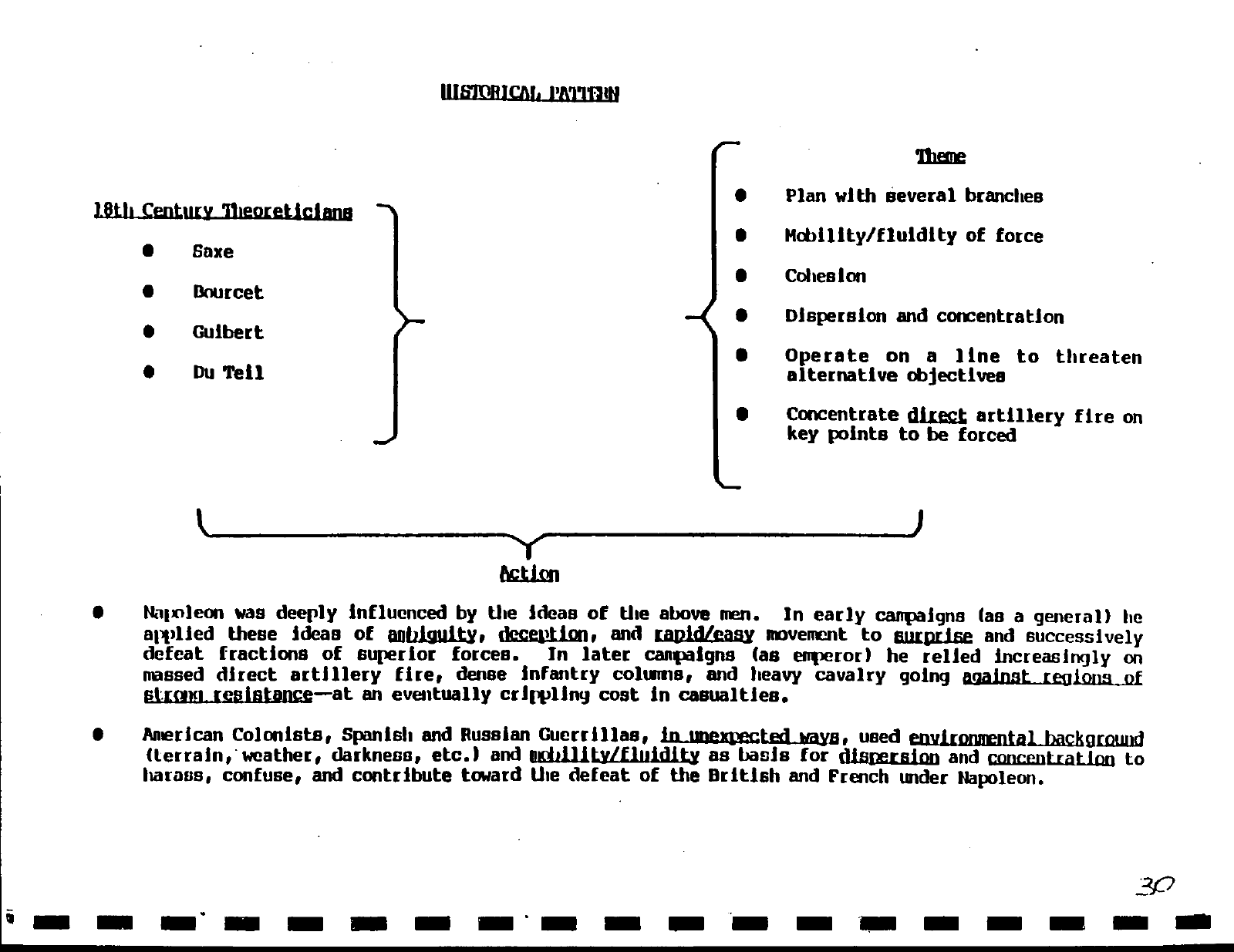
18th-century theoreticians

Theoreticians

  • Saxe
  • Bourcet
  • Guibert
  • Du Teil

Theme

  • Plan with several branches
  • Mobility/fluidity of force
  • Cohesion
  • Dispersion and concentration
  • Operate on a line to threaten alternative objectives
  • Concentrate direct artillery fire on key points to be forced

Action

  • Napoleon was deeply influenced by the ideas of the above men. In early campaigns (as a general) he applied these ideas of ambiguity, deception, and rapid/easy movement to surprise and successively defeat fractions of superior forces. In later campaigns (as emperor) he relied increasingly on massed direct artillery fire, dense infantry columns, and heavy cavalry going against regions of strong resistance—at an eventually crippling cost in casualties.
  • American Colonists, Spanish and Russian Guerrillas, in unexpected ways, used environmental background (terrain, weather, darkness, etc.) and mobility/fluidity as basis for dispersion and concentration to harass, confuse, and contribute toward the defeat of the British and French under Napoleon.
30

Impression: regular and guerrilla war

1986 PDF p.34 · Richards/Spinney revised PDF p.33

Unretouched 1986 scan, printed slide 32
Full 1986 page; source geometry, not the later deck.
1986 · printed slide 32

Impression

The ideas of Sun Tzu, Saxe, Bourcet, and Guibert seem to be at home with either

Regular or Guerrilla Warfare.

32

Napoleon's art of war — revolutionary army gifts

1986 PDF p.35 · Richards/Spinney revised PDF p.34

Unretouched 1986 scan, printed slide 33
Full 1986 page; source geometry, not the later deck.
1986 · printed slide 33

Napoleon’s art of war

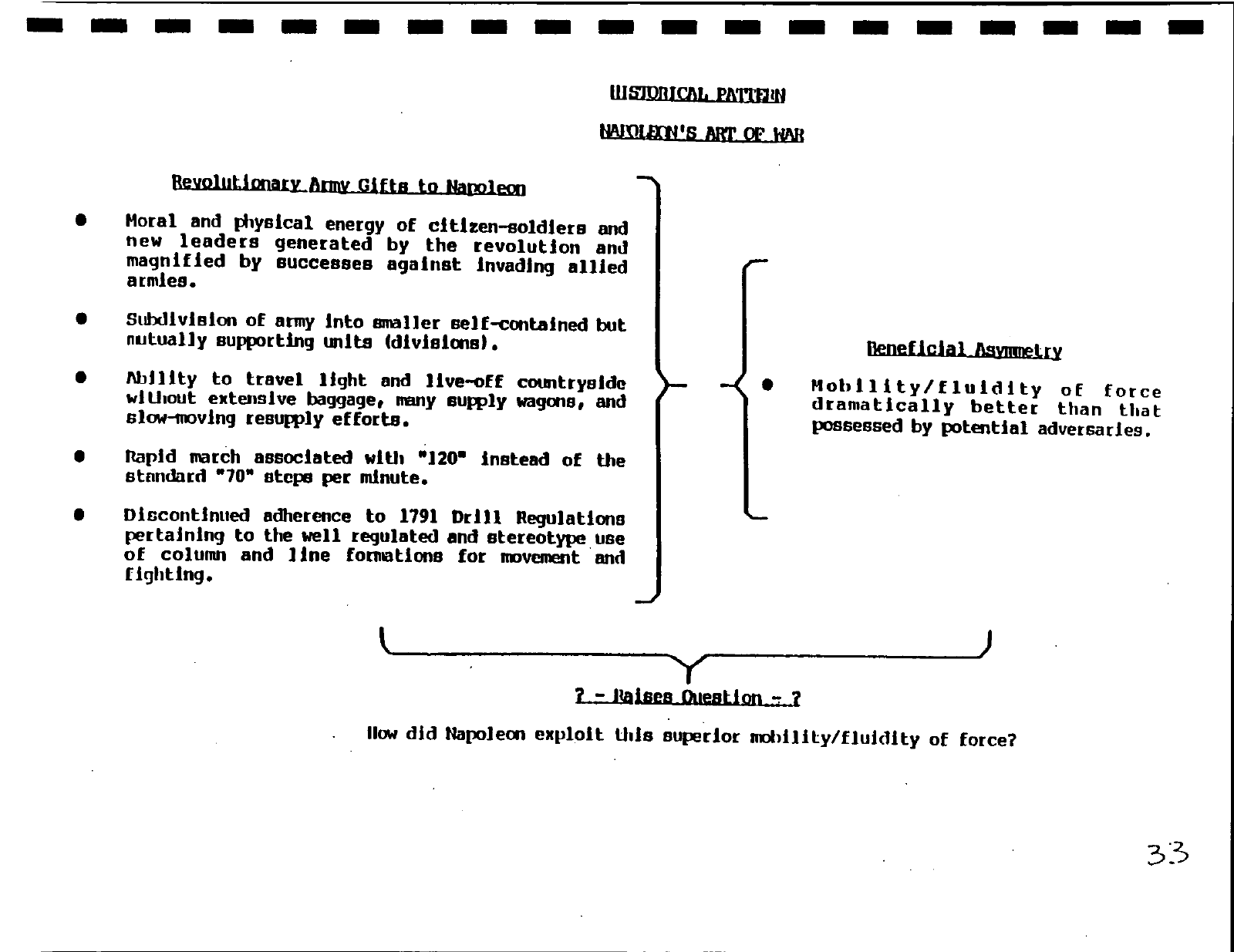
Revolutionary army gifts to Napoleon

  • Moral and physical energy of citizen-soldiers and new leaders generated by the revolution and magnified by successes against invading allied armies.
  • Subdivision of army into smaller self-contained but mutually supporting units (divisions).
  • Ability to travel light and live-off countryside without extensive baggage, many supply wagons, and slow-moving resupply efforts.
  • Rapid march associated with “120” instead of the standard “70” steps per minute.
  • Discontinued adherence to 1791 Drill Regulations pertaining to the well regulated and stereotype use of column and line formations for movement and fighting.

Beneficial asymmetry

Mobility/fluidity of force dramatically better than that possessed by potential adversaries.

? — Raises question — ?

How did Napoleon exploit this superior mobility/fluidity of force?

33

Napoleon's art of war — general features

1986 PDF p.36 · Richards/Spinney revised PDF p.35

Unretouched 1986 scan, printed slide 34
Full 1986 page; source geometry, not the later deck.
1986 · printed slide 34

Napoleon’s art of war

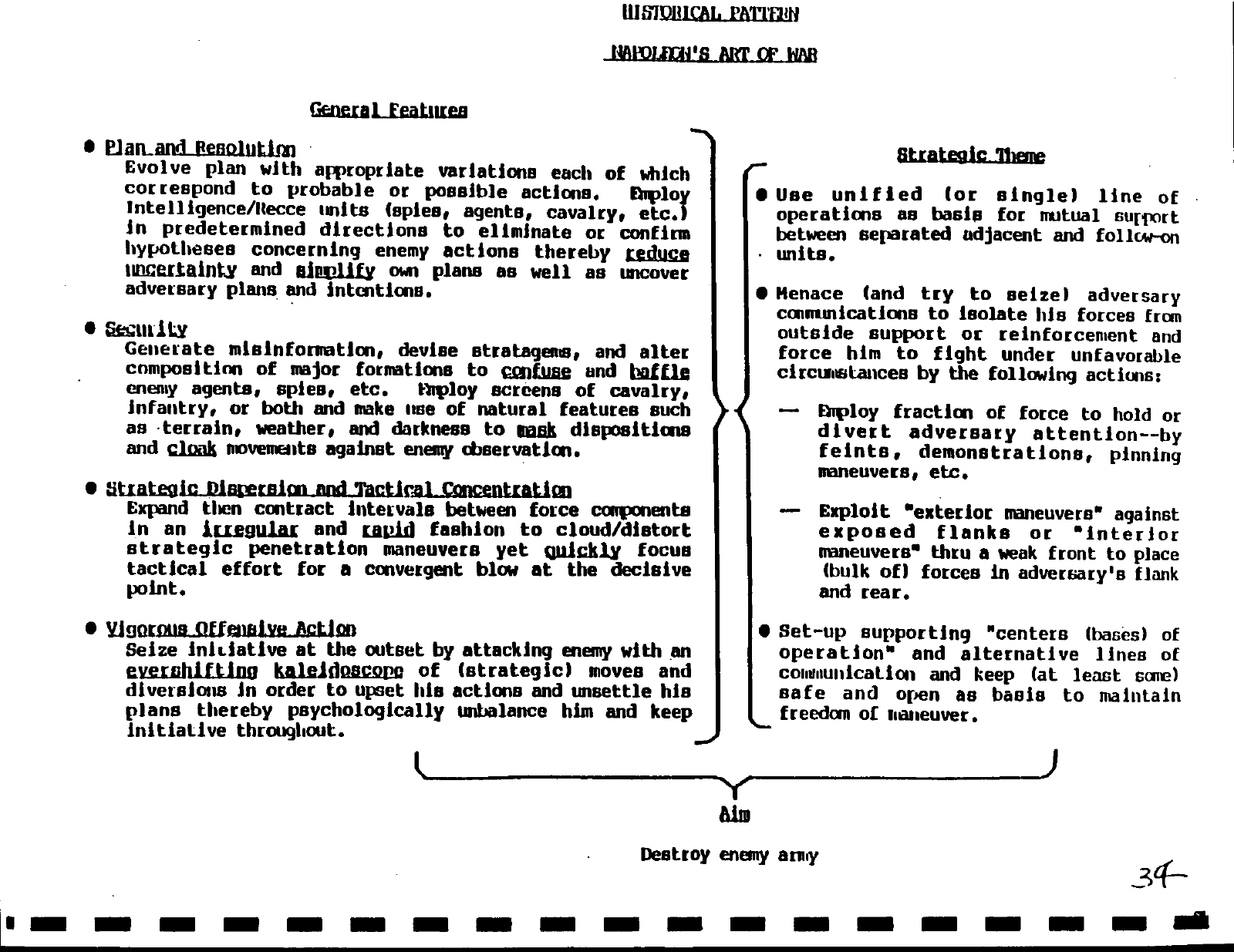
General features

  • Plan and Resolution

    Evolve plan with appropriate variations each of which correspond to probable or possible actions. Employ Intelligence/Recce units (spies, agents, cavalry, etc.) in predetermined directions to eliminate or confirm hypotheses concerning enemy actions thereby reduce uncertainty and simplify own plans as well as uncover adversary plans and intentions.

  • Security

    Generate misinformation, devise stratagems, and alter composition of major formations to confuse and baffle enemy agents, spies, etc. Employ screens of cavalry, infantry, or both and make use of natural features such as terrain, weather, and darkness to mask dispositions and cloak movements against enemy observation.

  • Strategic Dispersion and Tactical Concentration

    Expand then contract intervals between force components in an irregular and rapid fashion to cloud/distort strategic penetration maneuvers yet quickly focus tactical effort for a convergent blow at the decisive point.

  • Vigorous Offensive Action

    Seize initiative at the outset by attacking enemy with an ever-shifting kaleidoscope of (strategic) moves and diversions in order to upset his actions and unsettle his plans thereby psychologically unbalance him and keep initiative throughout.

Strategic theme

  • Use unified (or single) line of operations as basis for mutual support between separated adjacent and follow-on units.
  • Menace (and try to seize) adversary communications to isolate his forces from outside support or reinforcement and force him to fight under unfavorable circumstances by the following actions:
    • Employ fraction of force to hold or divert adversary attention—by feints, demonstrations, pinning maneuvers, etc.
    • Exploit “exterior maneuvers” against exposed flanks or “interior maneuvers” thru a weak front to place (bulk of) forces in adversary’s flank and rear.
  • Set-up supporting “centers (bases) of operation” and alternative lines of communication and keep (at least some) safe and open as basis to maintain freedom of maneuver.

Aim

Destroy enemy army

34

Strategy of envelopment

1986 PDF p.37 · Richards/Spinney revised PDF p.36

Unretouched 1986 scan, printed slide 35
Full 1986 page; source geometry, not the later deck.
1986 · printed slide 35

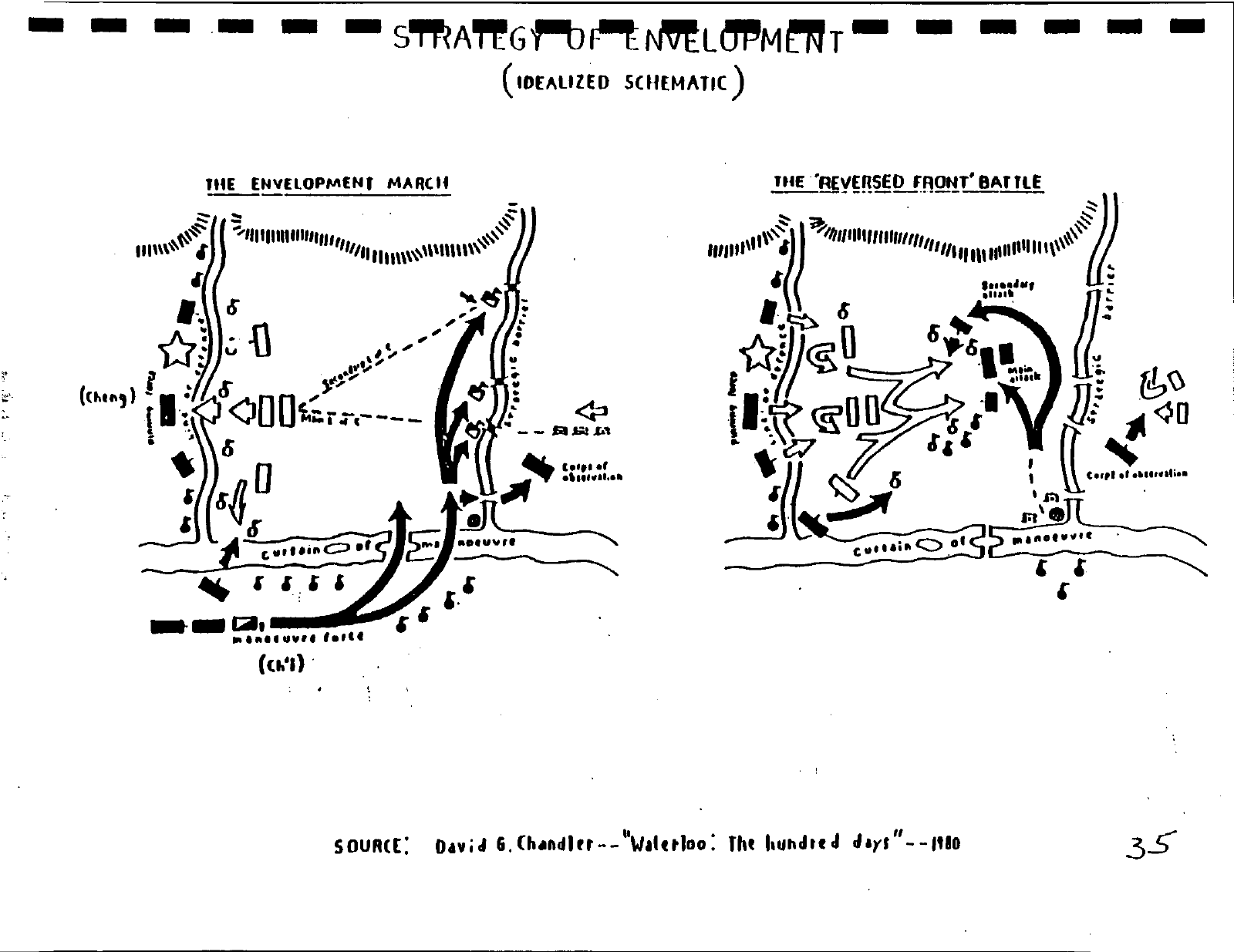
Strategy of envelopment

Idealized schematic · 1986 geometry

Strategy of envelopmentTwo stages: a pinning force holds the opponent while a maneuver force passes behind the strategic barrier, then reverses the front with a main and secondary attack. Cavalry screens, crossings, terrain and lines of communication remain visible. Not geographically calibrated.I · THE ENVELOPMENT MARCHII · THE REVERSED FRONT BATTLEcurtain ofmaneuverpinning forceline of defensestrategic barriercurtain ofmaneuverpinning forceline of defensestrategic barrierLOCCorps ofobservation(cheng)maneuver force(ch’i)Secondary attackmain attackCorps of observationTeal: filled source marks · Rust: open source marks · Dashed: lines of communicationEditorial colors; terrain, formations and movement paths traced from the 1986 schematic.
35

Strategy of central position

1986 PDF p.38 · Richards/Spinney revised PDF p.37

Unretouched 1986 scan, printed slide 36
Full 1986 page; source geometry, not the later deck.
1986 · printed slide 36

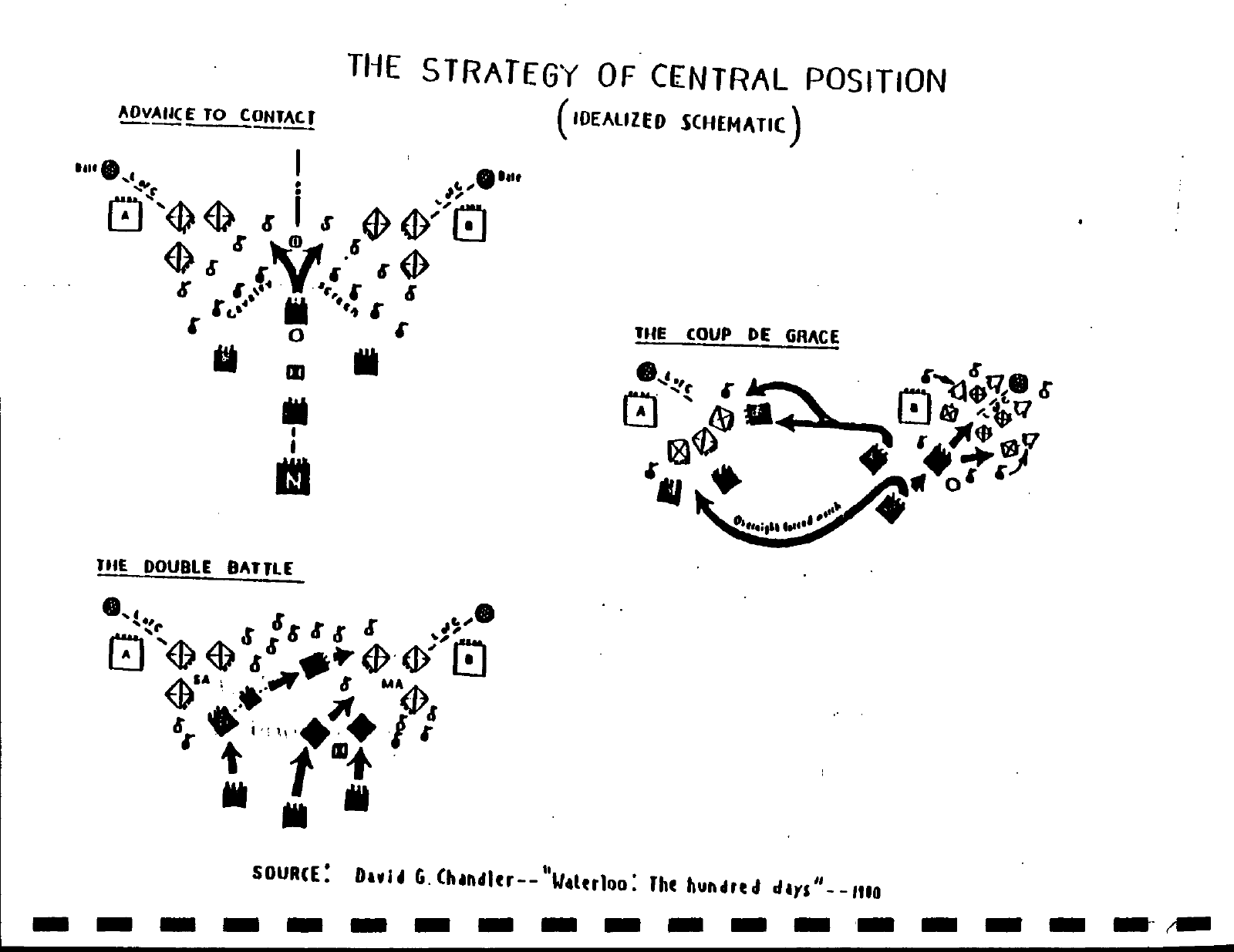
The strategy of central position

Idealized schematic · 1986 geometry

The strategy of central positionThree stages retain the 1986 layout: advance to contact above the double battle at left, coup de grace at right. A and B bases, opposing formations, cavalry screens, split advance, attacks and overnight forced march are shown; colors are not historical.I · ADVANCE TO CONTACTII · THE DOUBLE BATTLEIII · THE COUP DE GRÂCEbaseLOCAbaseLOCB××××××××××××××××××××××××××××××NOOcavalry screenbaseLOCAbaseLOCB××××××××××××××××××××××××××××××××××××××××××SAMANbaseLOCAbaseB××××××××××××××××××××××××××××××××××××××××××overnight forced marchOTeal: filled source formationsRust: open source formations (A and B)Dashed: lines of communication (LOC)SA / MA and O retained as source marks;not expanded from an uncertain reading.Source attribution on Boyd’s slide: David G. Chandler, Waterloo: The Hundred Days (1980).
36

Napoleon's art of war — tactics

1986 PDF p.39 · Richards/Spinney revised PDF p.38

Unretouched 1986 scan, printed slide 37
Full 1986 page; source geometry, not the later deck.
1986 · printed slide 37

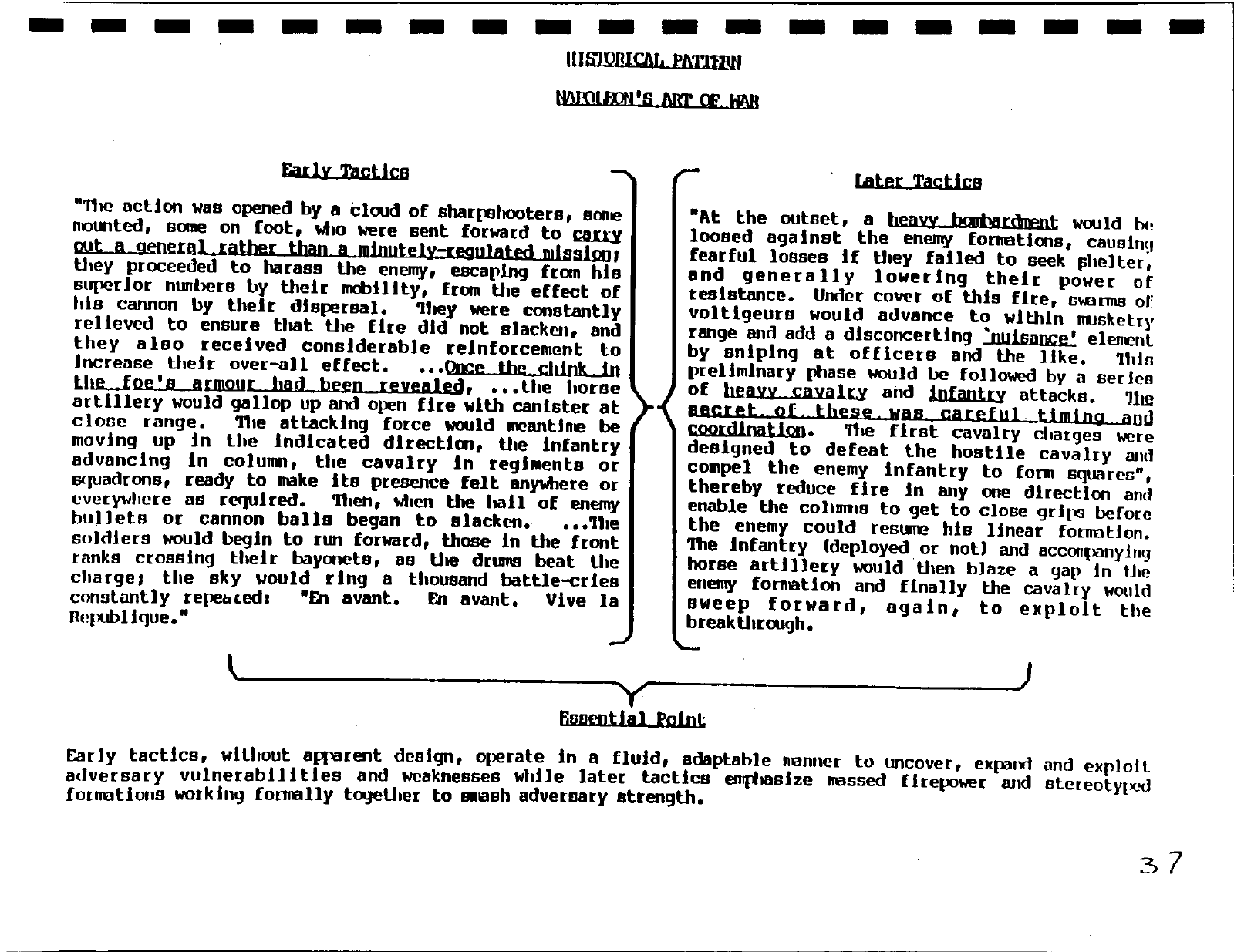
Napoleon’s art of war

Early tactics

“The action was opened by a cloud of sharpshooters, some mounted, some on foot, who were sent forward to carry out a general rather than a minutely-regulated mission; they proceeded to harass the enemy, escaping from his superior numbers by their mobility, from the effect of his cannon by their dispersal. They were constantly relieved to ensure that the fire did not slacken, and they also received considerable reinforcement to increase their over-all effect. … Once the chink in the foe’s armour had been revealed, …the horse artillery would gallop up and open fire with canister at close range. The attacking force would meantime be moving up in the indicated direction, the infantry advancing in column, the cavalry in regiments or squadrons, ready to make its presence felt anywhere or everywhere as required. Then, when the hail of enemy bullets or cannon balls began to slacken. …The soldiers would begin to run forward, those in the front ranks crossing their bayonets, as the drums beat the charge; the sky would ring a thousand battle-cries constantly repeated: ‘En avant. En avant. Vive la République.’”

Later tactics

“At the outset, a heavy bombardment would be loosed against the enemy formations, causing fearful losses if they failed to seek shelter, and generally lowering their power of resistance. Under cover of this fire, swarms of voltigeurs would advance to within musketry range and add a disconcerting ‘nuisance’ element by sniping at officers and the like. This preliminary phase would be followed by a series of heavy cavalry and infantry attacks. The secret of these was careful timing and coordination. The first cavalry charges were designed to defeat the hostile cavalry and compel the enemy infantry to form squares”, thereby reduce fire in any one direction and enable the columns to get to close grips before the enemy could resume his linear formation. The infantry (deployed or not) and accompanying horse artillery would then blaze a gap in the enemy formation and finally the cavalry would sweep forward, again, to exploit the breakthrough.

Essential point

Early tactics, without apparent design, operate in a fluid, adaptable manner to uncover, expand and exploit adversary vulnerabilities and weaknesses while later tactics emphasize massed firepower and stereotyped formations working formally together to smash adversary strength.

37

The Napoleonic spirit

1986 PDF p.41 · Richards/Spinney revised PDF p.40

Unretouched 1986 scan, printed slide 39
Full 1986 page; source geometry, not the later deck.
1986 · printed slide 39

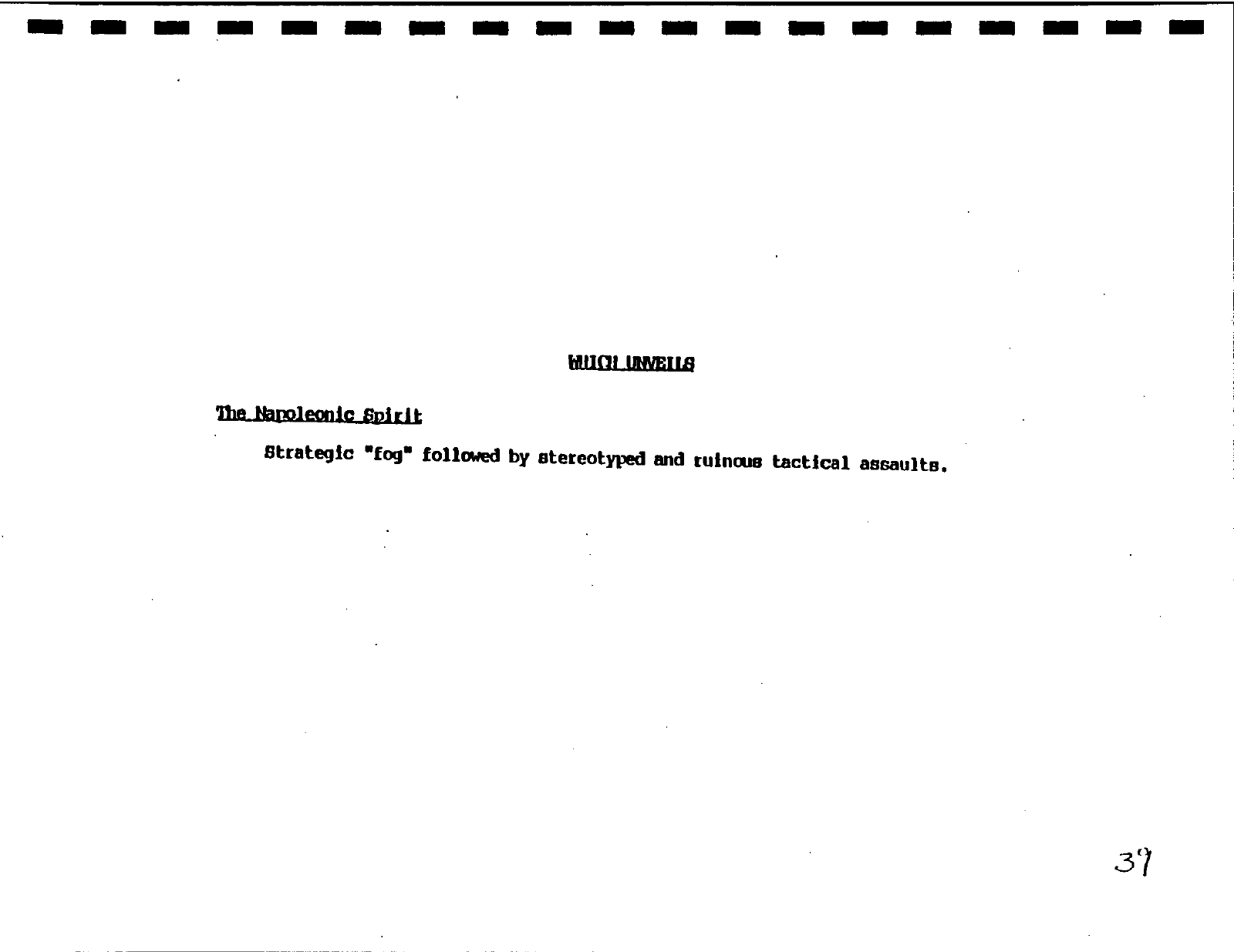
Which unveils

The Napoleonic spirit

Strategic “fog” followed by stereotyped and ruinous tactical assaults.

39

Clausewitz — character of war and strategy

1986 PDF p.42 · Richards/Spinney revised PDF p.41

Unretouched 1986 scan, printed slide 40
Full 1986 page; source geometry, not the later deck.
1986 · printed slide 40

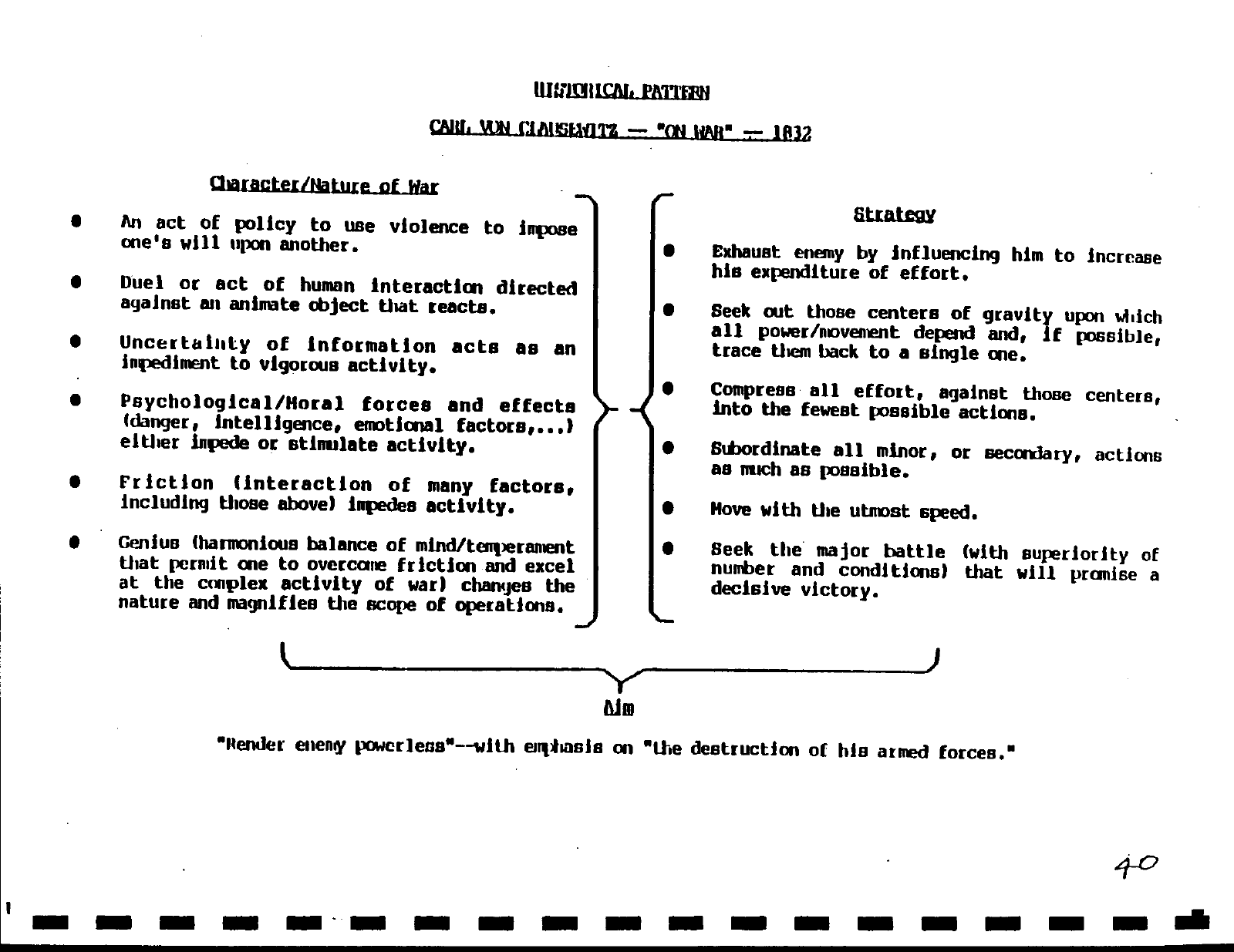
Carl von Clausewitz · On War · 1832

Character/nature of war

  • An act of policy to use violence to impose one’s will upon another.
  • Duel or act of human interaction directed against an animate object that reacts.
  • Uncertainty of information acts as an impediment to vigorous activity.
  • Psychological/Moral forces and effects (danger, intelligence, emotional factors,…) either impede or stimulate activity.
  • Friction (interaction of many factors, including those above) impedes activity.
  • Genius (harmonious balance of mind/temperament that permit one to overcome friction and excel at the complex activity of war) changes the nature and magnifies the scope of operations.

Strategy

  • Exhaust enemy by influencing him to increase his expenditure of effort.
  • Seek out those centers of gravity upon which all power/movement depend and, if possible, trace them back to a single one.
  • Compress all effort, against those centers, into the fewest possible actions.
  • Subordinate all minor, or secondary, actions as much as possible.
  • Move with the utmost speed.
  • Seek the major battle (with superiority of number and conditions) that will promise a decisive victory.

Aim

“Render enemy powerless”—with emphasis on “the destruction of his armed forces.”

40