Slide source comparison

Reading

Counter-blitz — continuation

1986 slides · PDF p.107 · Revised slides · PDF p.106 · Compare slides

1986 PDF p.107
Full 1986 original slide 105

Reading panel

Printed slide 105

Counter-blitz — continuation

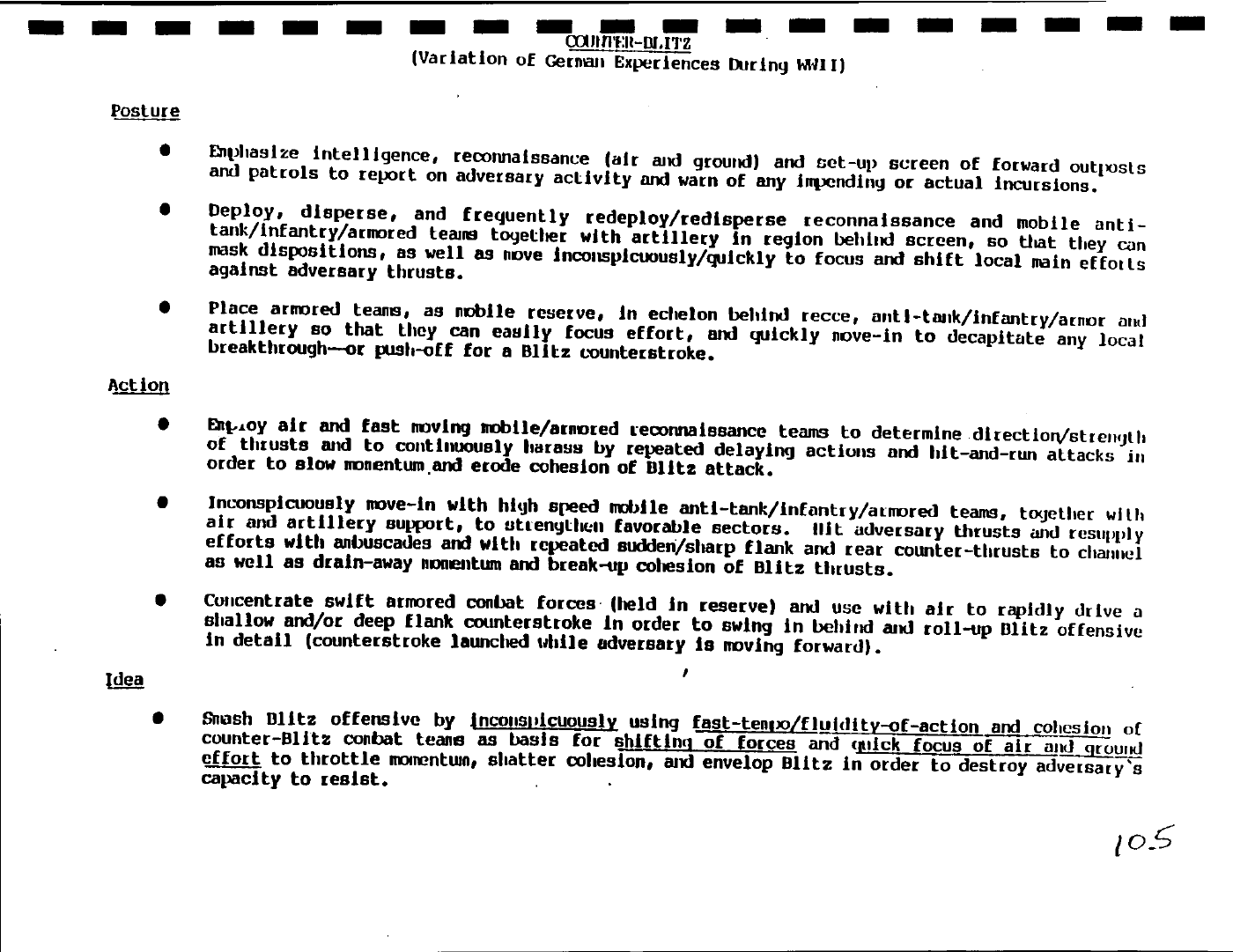
(Variation of German experiences during WWII)

Posture

• Emphasize intelligence, reconnaissance (air and ground) and set up screen of forward outposts and patrols to report on adversary activity and warn of any impending or actual incursions.

• Deploy, disperse, and frequently redeploy/redisperse reconnaissance and mobile antitank/infantry/armored teams together with artillery in region behind screen so that they can mask dispositions as well as move inconspicuously/quickly to focus and shift local main efforts against adversary thrusts.

• Place armored teams, as mobile reserve, in echelon behind recce, anti-tank/infantry/armor and artillery so that they can easily focus effort and quickly move in to decapitate any local breakthrough—or push off for a blitz counterstroke.

Action

• Employ air and fast moving mobile/armored reconnaissance teams to determine direction/strength of thrusts and to continuously harass by repeated delaying actions and hit-and-run attacks in order to slow momentum and erode cohesion of blitz attack.

• Inconspicuously move in with high-speed mobile anti-tank/infantry/armored teams together with air and artillery support to strengthen favorable sectors. Hit adversary thrusts and resupply efforts with ambuscades and with repeated sudden/sharp flank and rear counter-thrusts to channel as well as drain- away momentum and break up cohesion of blitz thrusts.

• Concentrate swift armored combat forces (held in reserve) and use with air to rapidly drive a shallow and/or deep flank counterstroke in order to swing in behind and roll-up blitz offensive in detail (counterstroke launched while adversary is moving forward).

Idea

• Smash blitz offensive by inconspicuously using fast-tempo/fluidity-of-action and cohesion of counter- blitz combat teams as basis for shifting of forces and quick focus of air and ground effort to throttle momentum, shatter cohesion, and envelop blitz in order to destroy adversary’s capacity to resist.
105

Blitz and counter-blitz

1986 slides · PDF p.108 · Revised slides · PDF p.107 · Compare slides

1986 PDF p.108

Full 1986 original slide 106

Reading panel

Printed slide 106

Blitz and counter-blitz

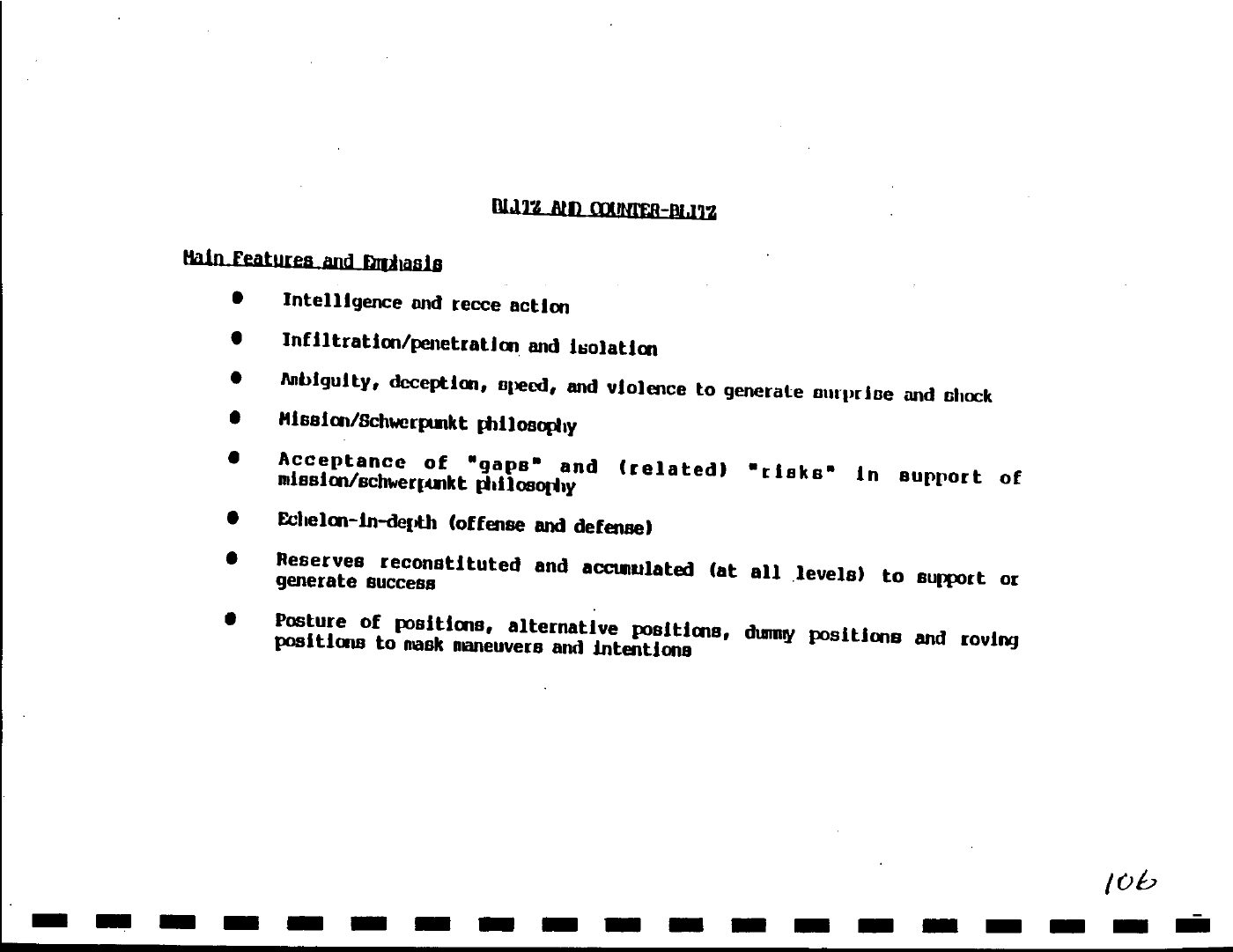
Main features and emphasis

• Intelligence and recce action

• Infiltration/penetration and isolation

• Ambiguity, deception, speed, and violence to generate surprise and shock

• Mission/Schwerpunkt philosophy

• Acceptance of “gaps” and (related) “risks” in support of mission/ Schwerpunkt philosophy

• Echelon-in-depth (offense and defense)

• Reserves reconstituted and accumulated (at all levels) to support or generate success

• Posture of positions, alternative positions, dummy positions and roving positions to mask maneuvers and intentions

106

Guerrilla/counter-guerrilla campaigns

1986 slides · PDF p.109 · Revised slides · PDF p.108 · Compare slides

1986 PDF p.109

Full 1986 original slide 107

Reading panel

Printed slide 107

Guerrilla/counter-guerrilla campaigns

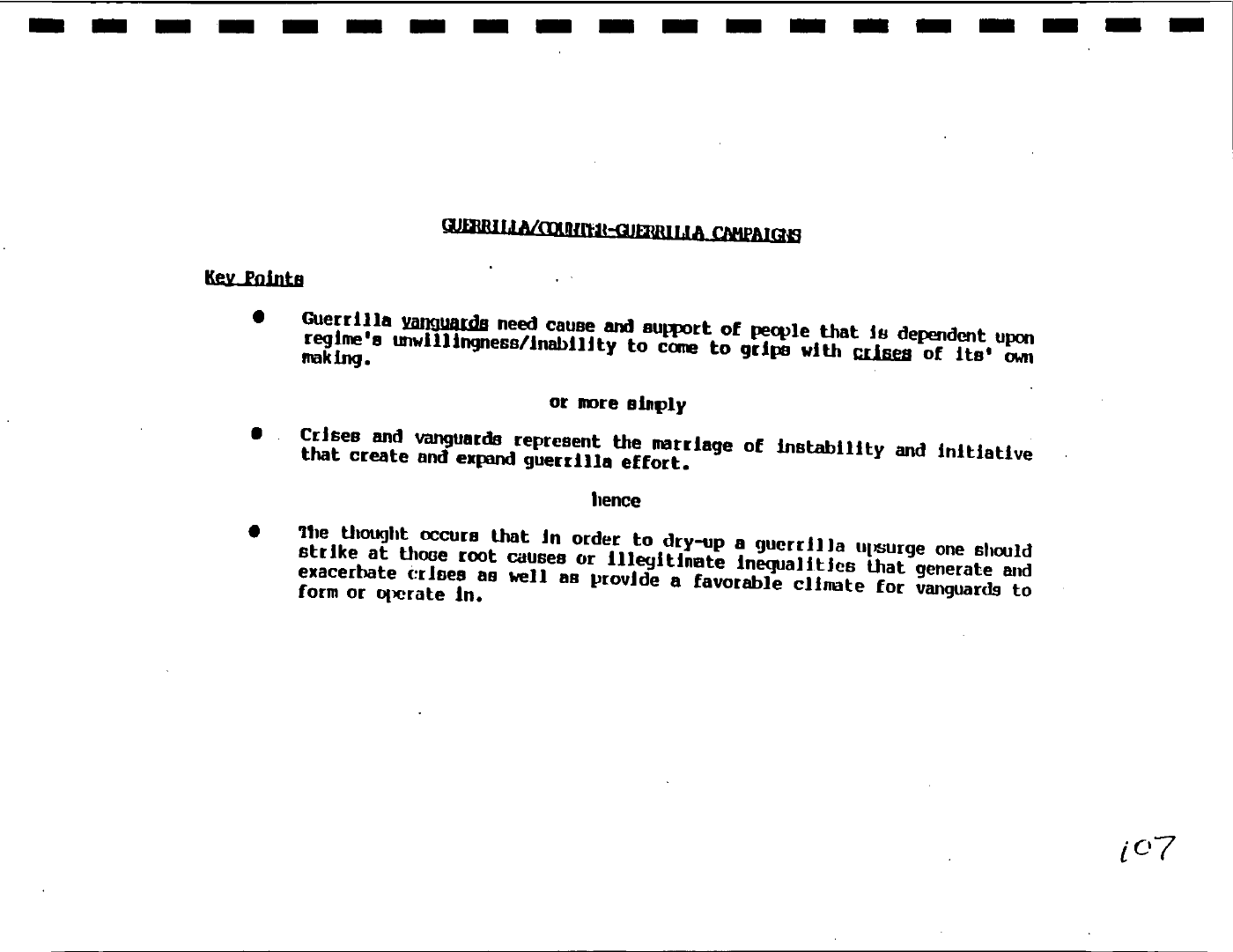
Key points

• Guerrilla vanguards need cause and support of people that is dependent upon regime’s unwillingness/inability to come to grips with crises of its own making.

Or more simply,

• Crises and vanguards represent the marriage of instability and initiative that create and expand guerrilla effort.

Hence,

• The thought occurs that in order to dry up a guerrilla upsurge, one should strike at those root causes or illegitimate inequalities that generate and exacerbate crises as well as provide a favorable climate for vanguards to form or operate in.

107

Counter-guerrilla campaign

1986 slides · PDF p.110 · Revised slides · PDF p.109 · Compare slides

1986 PDF p.110

Full 1986 original slide 108

Reading panel

Printed slide 108

Counter-guerrilla campaign

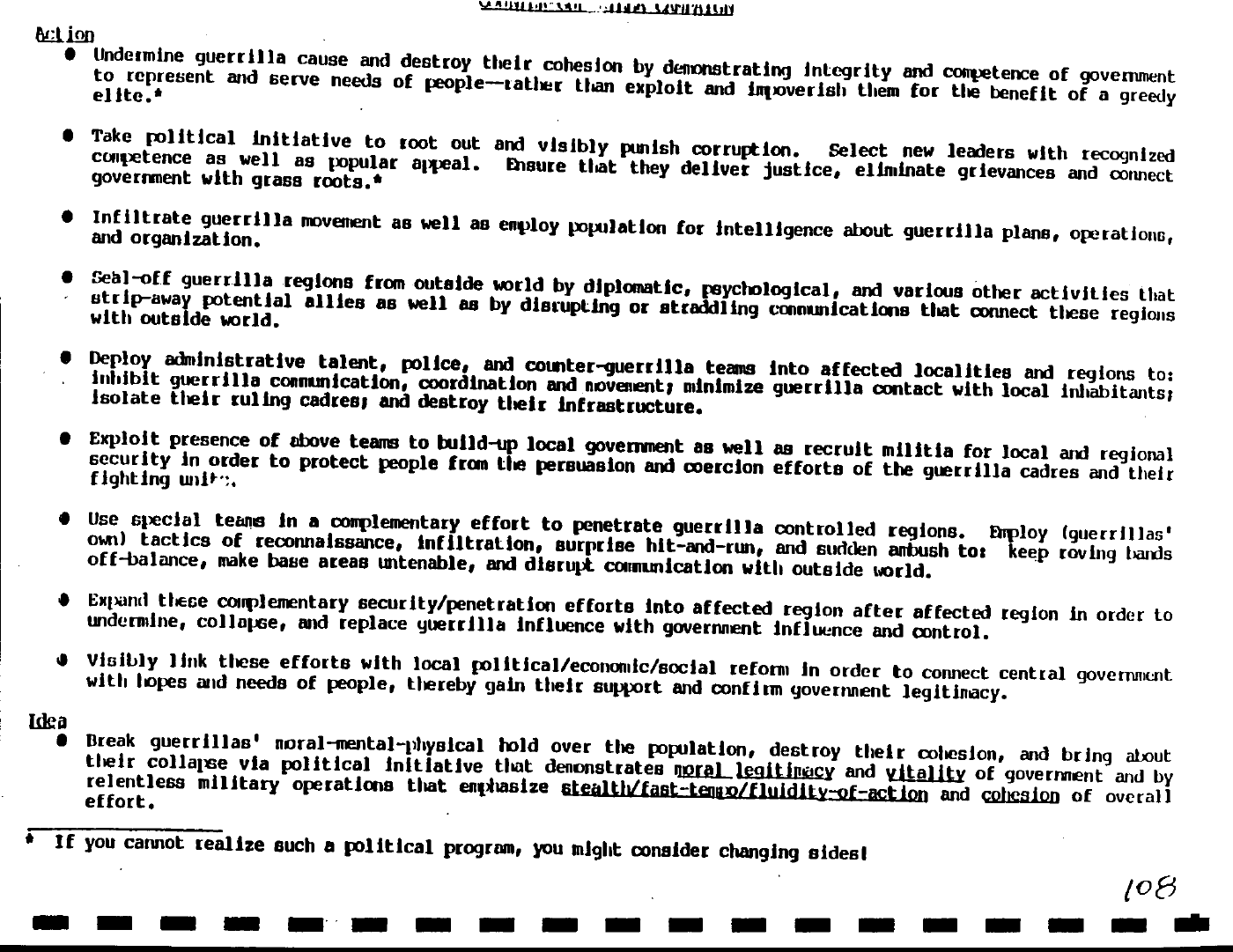
Action

• Undermine guerrilla cause and destroy their cohesion by demonstrating integrity and competence of government to represent and serve needs of people—rather than exploit and impoverish them for the benefit of a greedy elite.*

• Take political initiative to root out and visibly punish corruption. Select new leaders with recognized competence as well as popular appeal. Ensure that they deliver justice, eliminate grievances, and connect government with grass roots.*

• Infiltrate guerrilla movement as well as employ population for intelligence about guerrilla plans, operations, and organization.

• Seal off guerrilla regions from outside world by diplomatic, psychological, and various other activities that strip away potential allies as well as by disrupting or straddling communications that connect these regions with outside world.

• Deploy administrative talent, police, and counter-guerrilla teams into affected localities and regions to inhibit guerrilla communication, coordination and movement; minimize guerrilla contact with local inhabitants; isolate their ruling cadres; and destroy their infrastructure.

• Exploit presence of above teams to build up local government as well as recruit militia for local and regional security in order to protect people from the persuasion and coercion efforts of the guerrilla cadres and their fighting units.

• Use special teams in a complementary effort to penetrate guerrilla-controlled regions. Employ (guerrillas’ own) tactics of reconnaissance, infiltration, surprise hit-and-run, and sudden ambush to keep roving bands off-balance, make base areas untenable, and disrupt communication with outside world.

• Expand these complementary security/penetration efforts into affected region after affected region in order to undermine, collapse, and replace guerrilla influence with government influence and control.

• Visibly link these efforts with local political/economic/social reform in order to connect central government with hopes and needs of people, thereby gain their support and confirm government legitimacy.

Idea

• Break guerrillas’ moral-mental-physical hold over the population, destroy their cohesion, and bring about their collapse via political initiative that demonstrates moral legitimacy and vitality of government and by relentless military operations that emphasize stealth/fast-tempo/fluidity-of-action and cohesion of overall effort.

* If you cannot realize such a political program, you might consider changing sides!

108

Popular support: note and insight

1986 slides · PDF p.111 · Revised slides · PDF p.110 · Compare slides

1986 PDF p.111

Full 1986 original slide 109

Reading panel

Printed slide 109

Popular support: note and insight

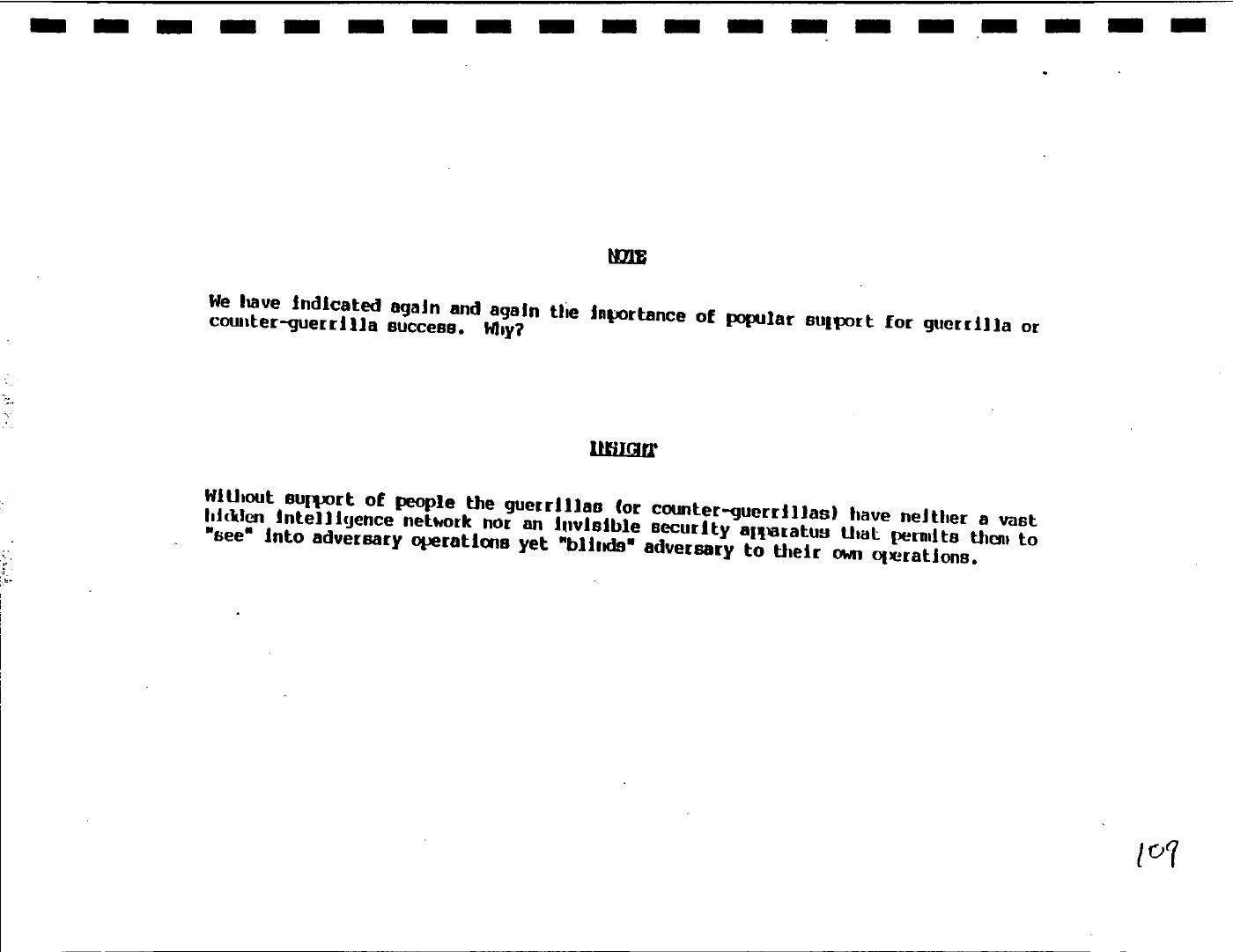
We have indicated again and again the importance of popular support for guerrilla or counter-guerrilla success. Why?

Insight

Without support of people the guerrillas (or counter- guerrillas) have neither a vast hidden intelligence network nor an invisible security apparatus that permits them to “see” into adversary operations yet “blinds” adversary to their own operations.

109

Categories of conflict — title

1986 slides · PDF p.112 · Revised slides · PDF p.111 · Compare slides

1986 PDF p.112

Full 1986 original slide 110

Reading panel

Printed slide 110

Categories of conflict — title

110

Categories of conflict

1986 slides · PDF p.113 · Revised slides · PDF p.112 · Compare slides

1986 PDF p.113

Full 1986 original slide 111

Reading panel

Printed slide 111

Categories of conflict

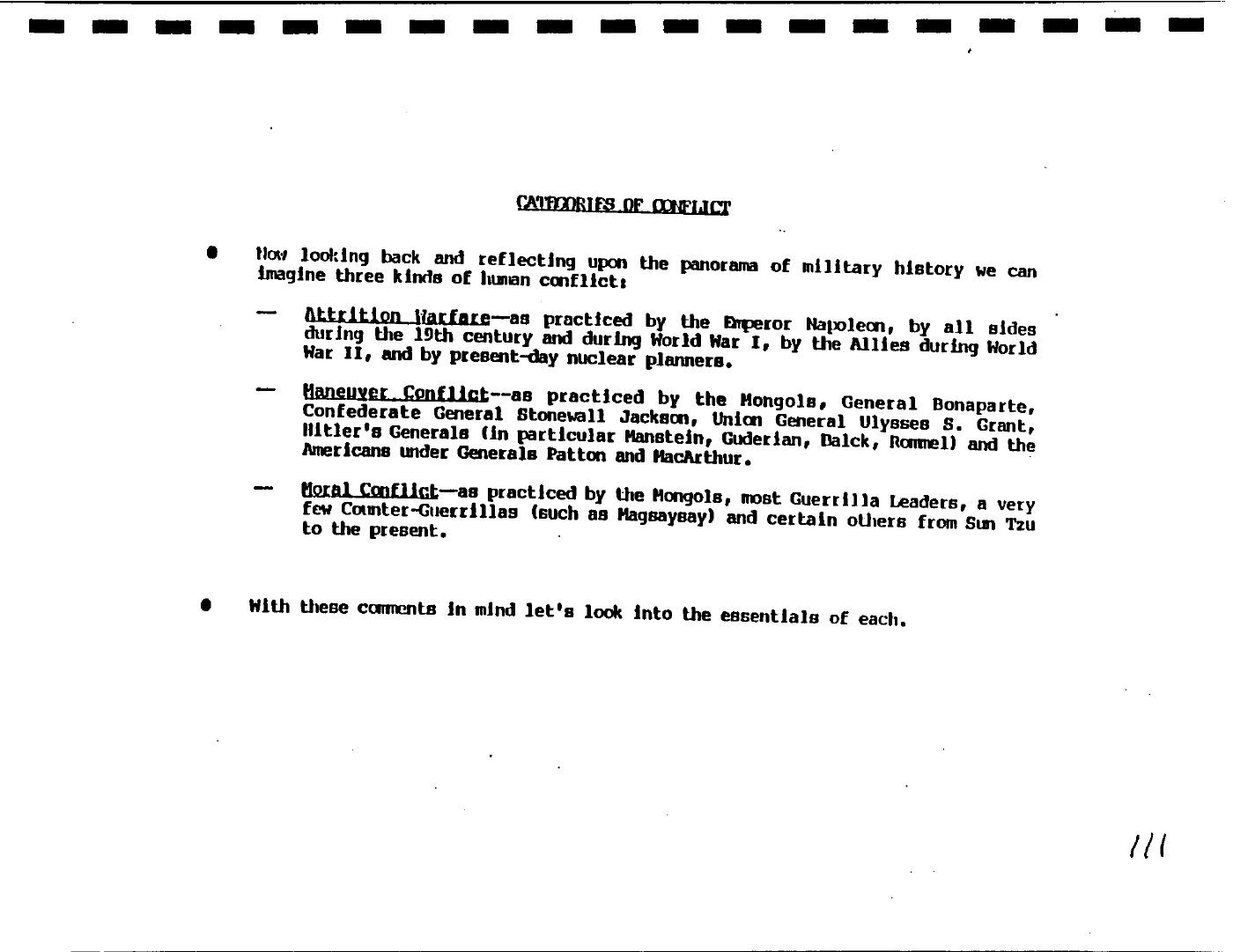
• Now looking back and reflecting upon the panorama of military history, we can imagine three kinds of human conflict:

– Attrition warfare—as practiced by the Emperor Napoleon, by all sides during the 19th century and during World War I, by the Allies during World War II, and by present-day nuclear planners.

– Maneuver conflict—as practiced by the Mongols, General Bonaparte, Confederate General Stonewall Jackson, Union General Ulysses S. Grant, Hitler’s generals (in particular Manstein, Guderian, Balck, Rommel) and the Americans under Generals Patton and MacArthur.

– Moral conflict—as practiced by the Mongols, most guerrilla leaders, a very few counter-guerrillas (such as Magsaysay) and certain others from Sun Tzu to the present.

• With these comments in mind let’s look into the essentials of each.

111

Attrition observations

1986 slides · PDF p.114 · Revised slides · PDF p.113 · Compare slides

1986 PDF p.114

Full 1986 original slide 112

Reading panel

Printed slide 112

Attrition observations

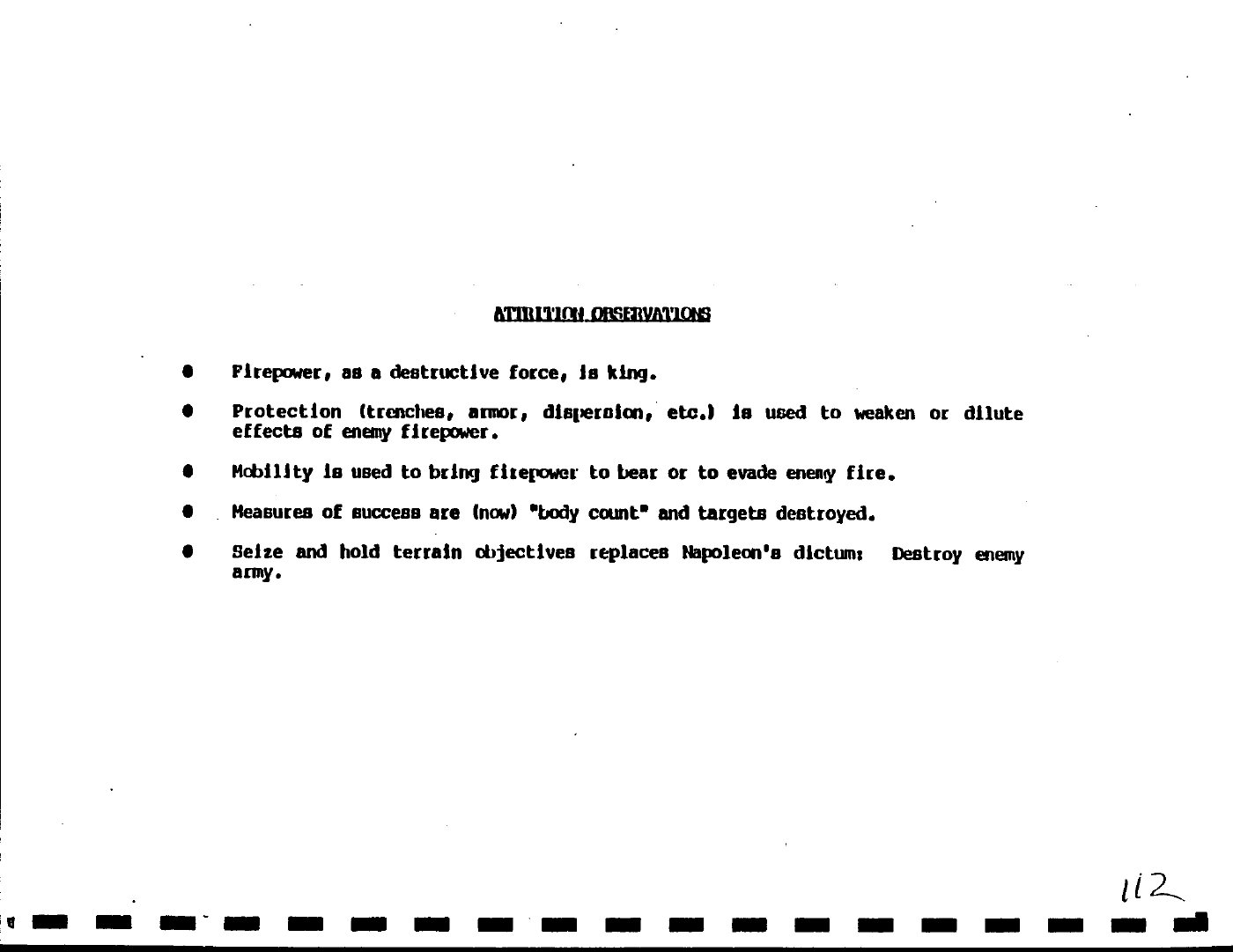
• Firepower, as a destructive force, is king.

• Protection (trenches, armor, dispersion, etc.) is used to weaken or dilute effects of enemy firepower.

• Mobility is used to bring firepower to bear or to evade enemy fire.

• Measures of success are (now) “body count” and targets destroyed.

• “Seize and hold terrain objectives” replaces Napoleon’s dictum: Destroy enemy army.

112

Essence of attrition warfare

1986 slides · PDF p.115 · Revised slides · PDF p.114 · Compare slides

1986 PDF p.115

Full 1986 original slide 113

Reading panel

1986 printed slide 113
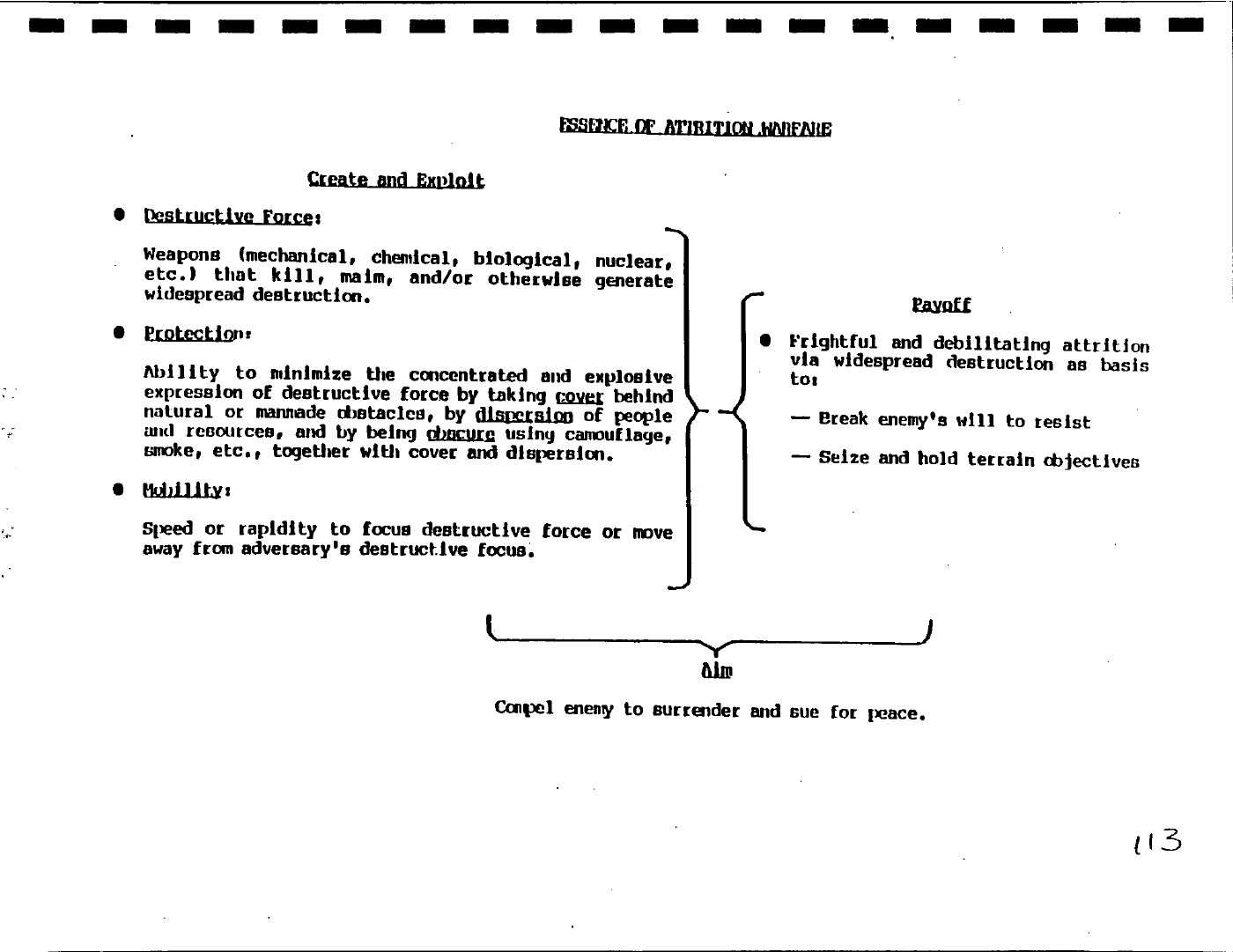
Essence of attrition warfare — 1986 brace-linked chartThree create-and-exploit factors at left are grouped by a right brace and linked across the center to a left brace grouping payoff at right. A horizontal lower brace joins both columns to the aim below.ESSENCE OF ATTRITION WARFARECreate and Exploit• Destructive Force:Weapons (mechanical, chemical, biological,nuclear, etc.) that kill, maim, and/or otherwisegenerate widespread destruction.• Protection:Ability to minimize the concentrated andexplosive expression of destructive force bytaking cover behind natural or manmade obstacles,by dispersion of people and resources, and bybeing obscure using camouflage, smoke, etc.,together with cover and dispersion.• Mobility:Speed or rapidity to focus destructive force ormove away from adversary’s destructive focus.Payoff• Frightful and debilitatingattrition via widespreaddestruction as basis to:— Break enemy’s will to resist— Seize and hold terrain objectivesAimCompel enemy to surrender and sue for peace.113

Observations regarding maneuver

1986 slides · PDF p.116 · Revised slides · PDF p.115 · Compare slides

1986 PDF p.116

Full 1986 original slide 114

Reading panel

Printed slide 114

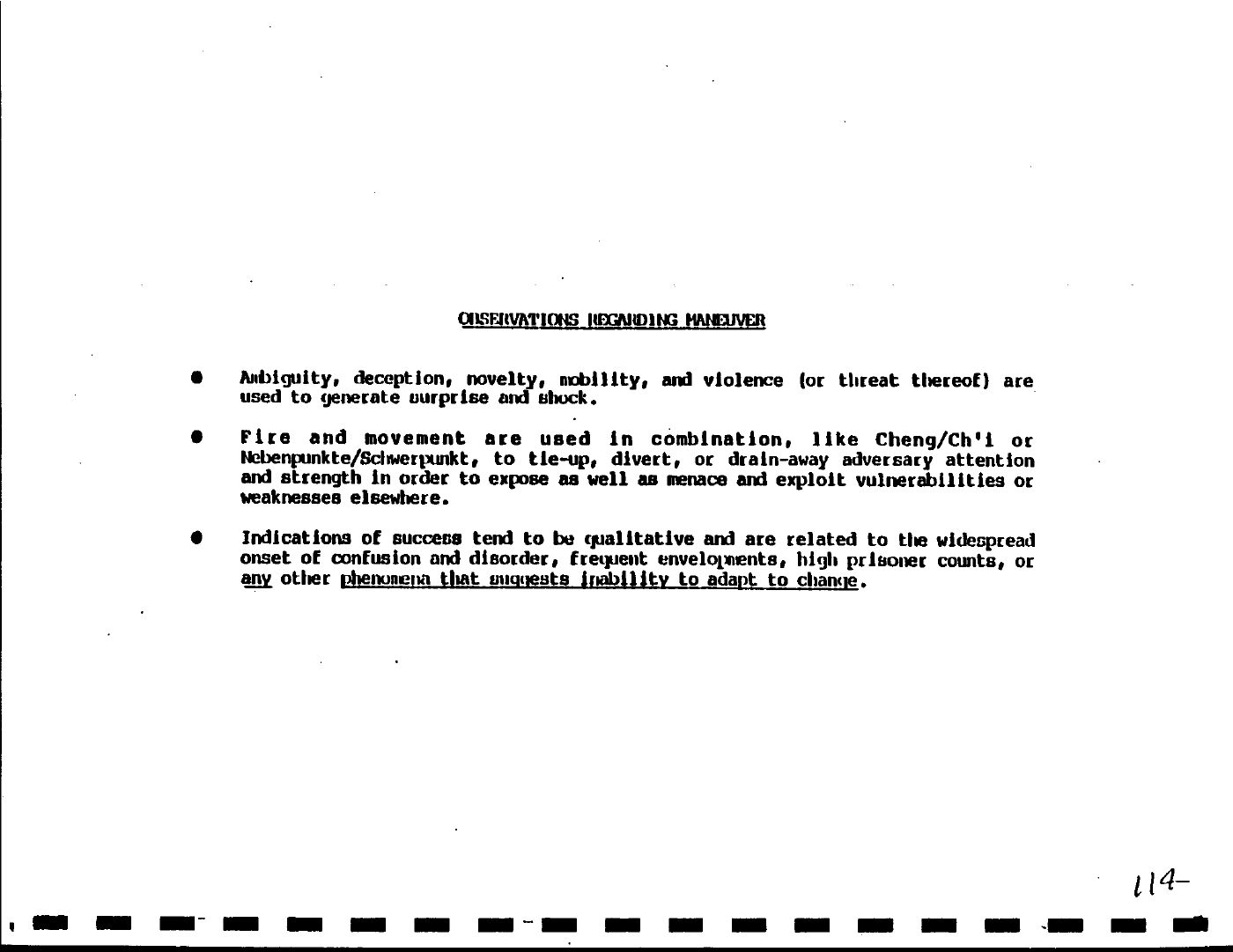
Observations regarding maneuver

• Ambiguity, deception, novelty, mobility, and violence (or threat thereof) are used to generate surprise and shock.

• Fire and movement are used in combination, like cheng/ch'i or Nebenpunkte/Schwerpunkt, to tie up, divert, or drain away adversary attention and strength in order to expose as well as menace and exploit vulnerabilities or weaknesses elsewhere.

• Indications of success tend to be qualitative and are related to the widespread onset of confusion and disorder, frequent envelopments, high prisoner counts, or any other phenomenon that suggests inability to adapt to change.

114

Essence of maneuver conflict

1986 slides · PDF p.117 · Revised slides · PDF p.116 · Compare slides

1986 PDF p.117

Full 1986 original slide 115

Reading panel

1986 printed slide 115
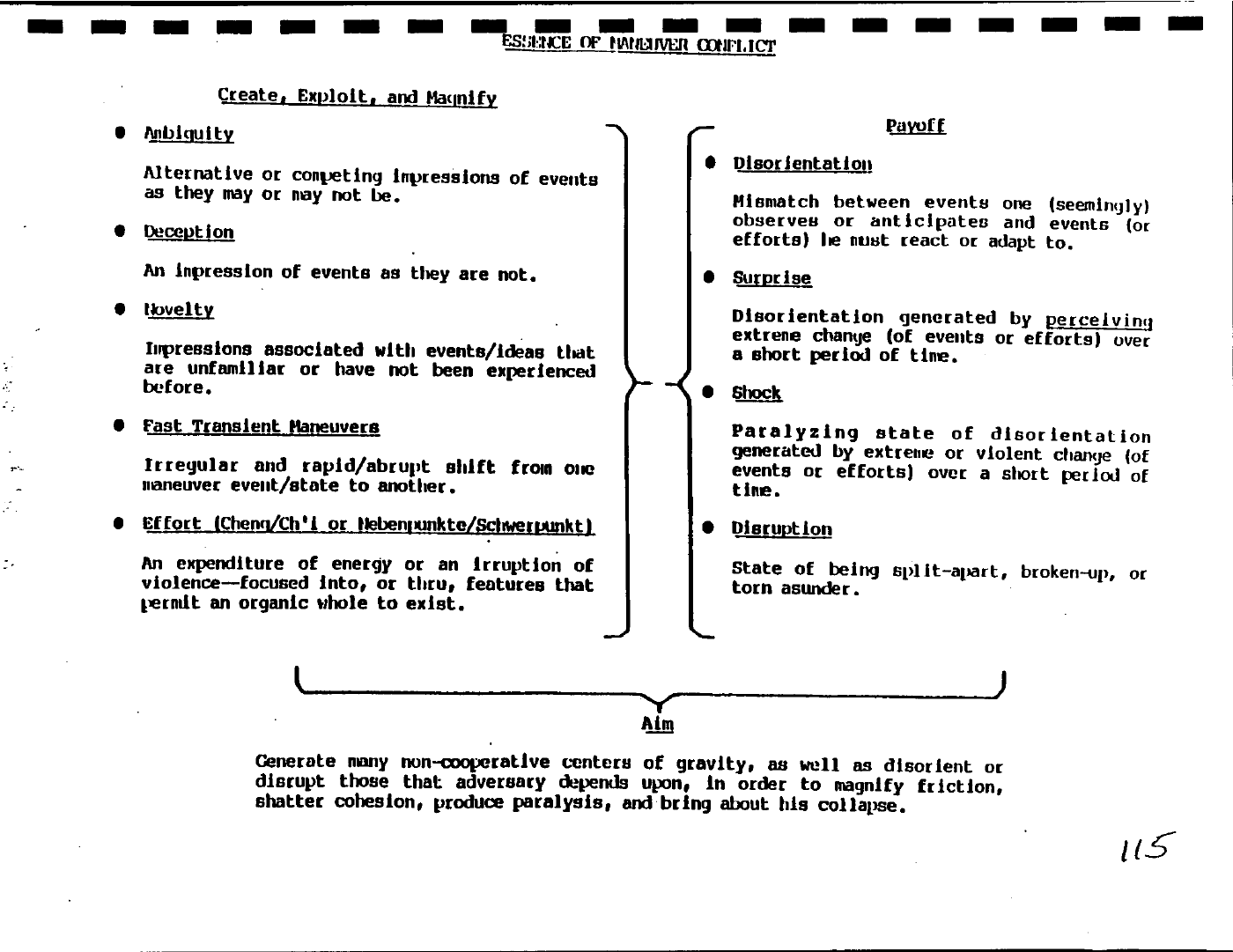
Essence of maneuver conflict — 1986 brace-linked chartFive factors at left are grouped and linked by paired facing braces to four payoffs at right. A bottom brace gathers both columns toward the aim. No arrows are present in this source chart.ESSENCE OF MANEUVER CONFLICTCreate, Exploit, and Magnify• AmbiguityAlternative or competing impressions ofevents as they may or may not be.• DeceptionAn impression of events as they are not.• NoveltyImpressions associated with events/ideas thatare unfamiliar or have not been experiencedbefore.• Fast Transient ManeuversIrregular and rapid/abrupt shift from onemaneuver event/state to another.• Effort (Cheng/Ch’i or Nebenpunkte/Schwerpunkt)An expenditure of energy or an irruption ofviolence—focused into, or thru, features thatpermit an organic whole to exist.Payoff• DisorientationMismatch between events one (seemingly)observes or anticipates and events (orefforts) he must react or adapt to.• SurpriseDisorientation generated by perceivingextreme change (of events or efforts)over a short period of time.• ShockParalyzing state of disorientationgenerated by extreme or violent change(of events or efforts) over a shortperiod of time.• DisruptionState of being split-apart, broken-up, ortorn asunder.AimGenerate many non-cooperative centers of gravity, as well as disorient or disrupt thosethat adversary depends upon, in order to magnify friction, shatter cohesion, produceparalysis, and bring about his collapse.115