1986 p.118 / revised p.117
Revised slides · PDF p.117 · 1986 slides · PDF p.118 · Compare slides
Revised slides · PDF p.117 · 1986 slides · PDF p.118 · Compare slides
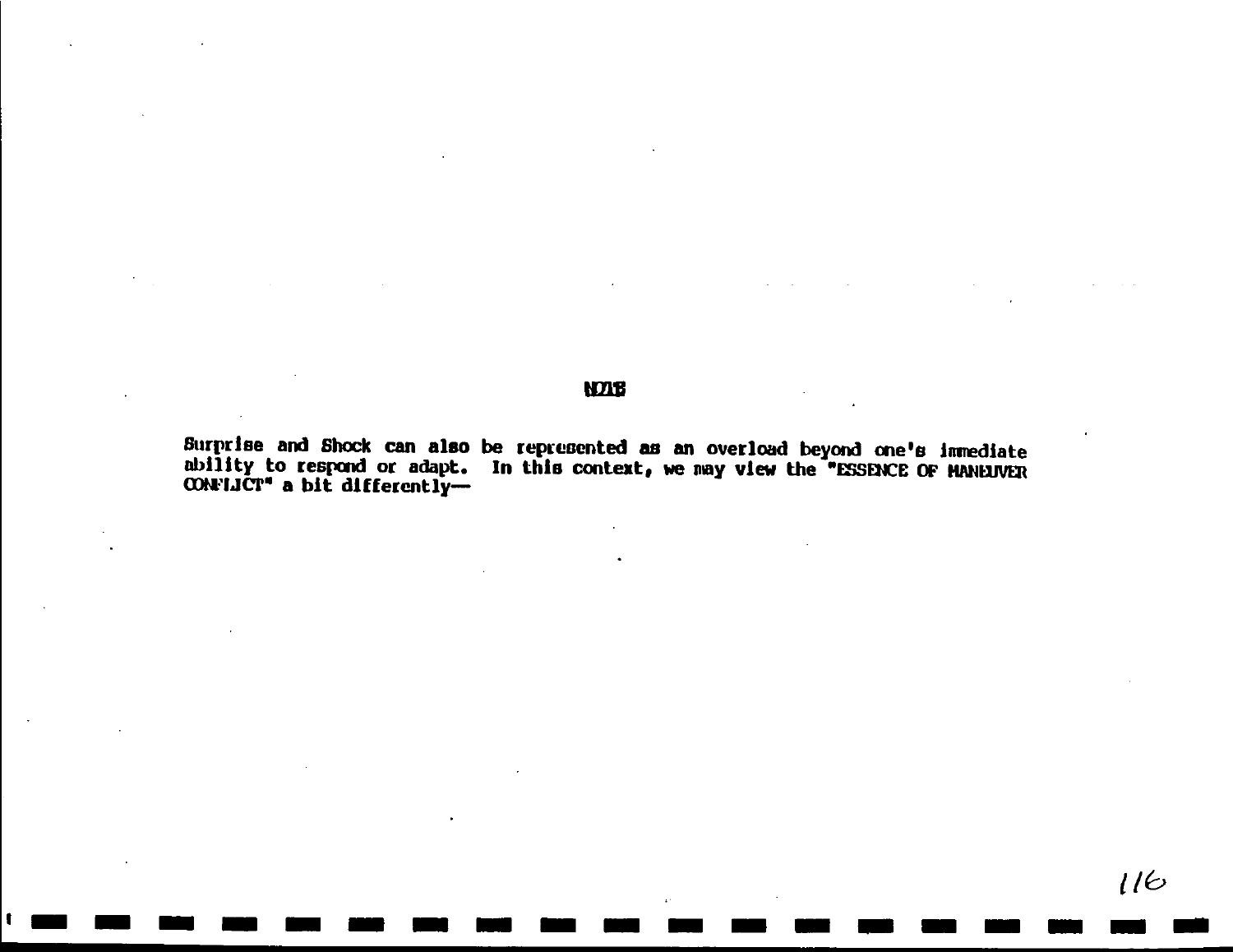
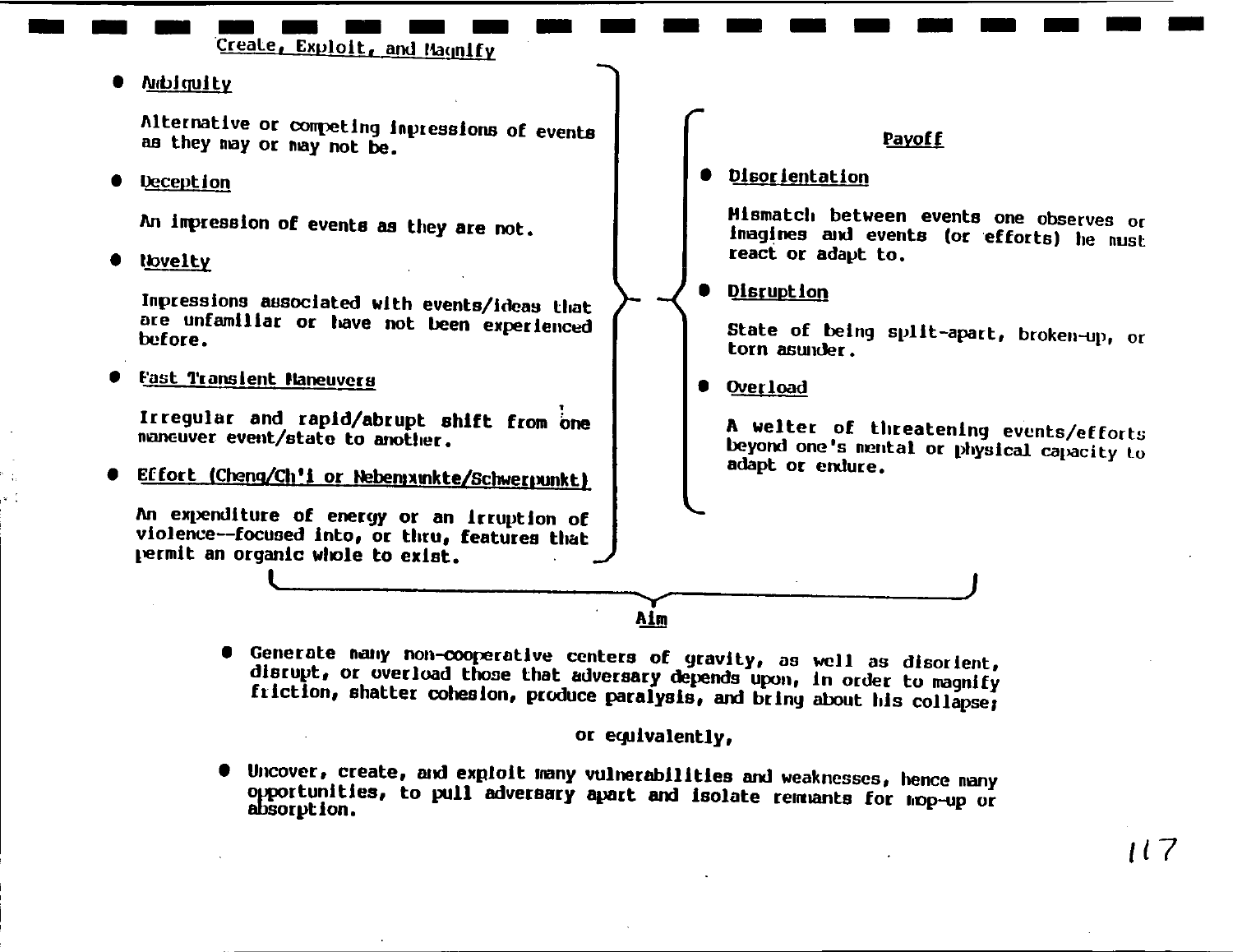
Surprise and shock can also be represented as an overload beyond one’s immediate ability to respond or adapt. In this context, we may view the “essence of maneuver conflict” a bit differently—
Revised slides · PDF p.118 · 1986 slides · PDF p.119 · Compare slides
Revised slides · PDF p.119 · 1986 slides · PDF p.120 · Compare slides
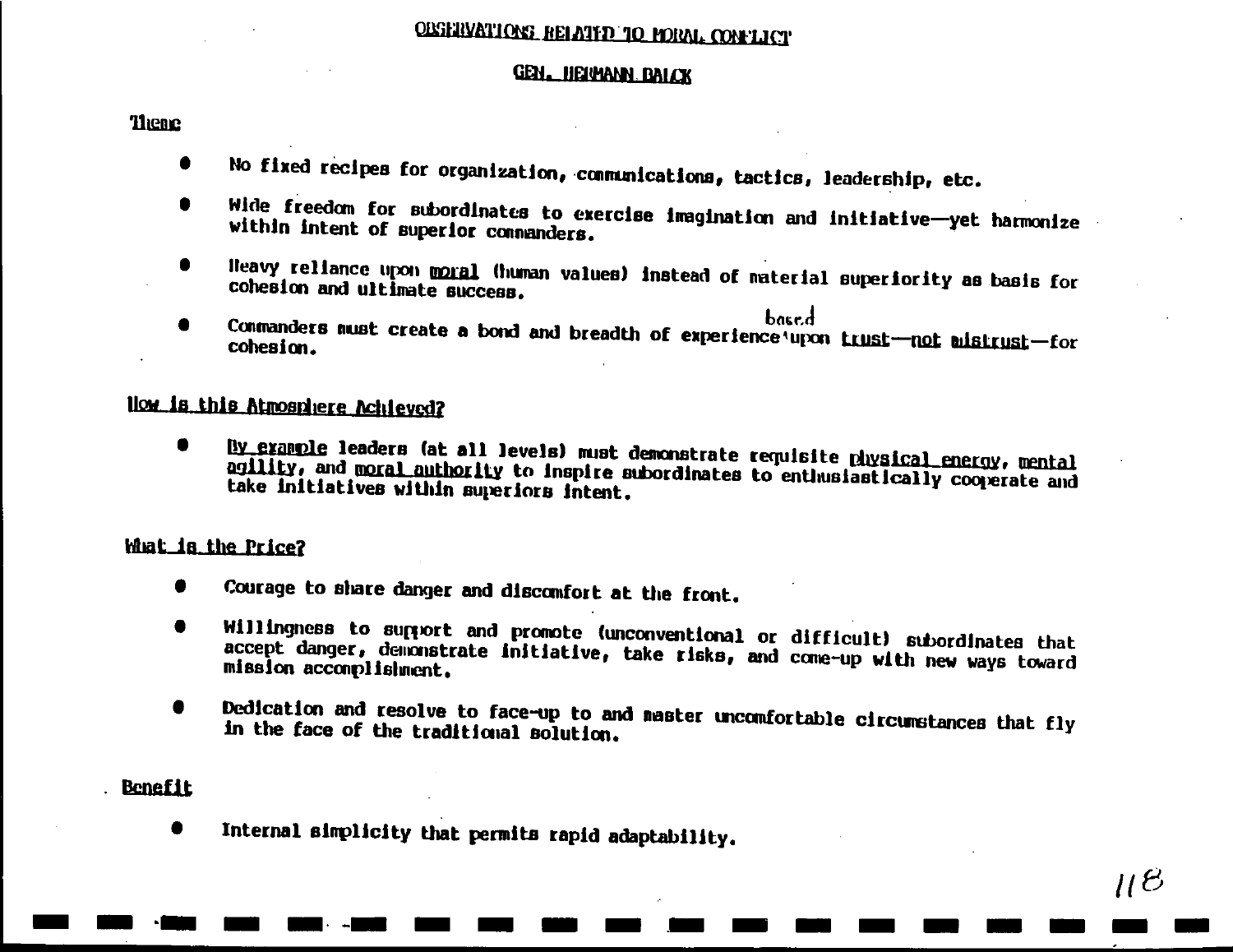
• No fixed recipes for organization, communications, tactics, leadership, etc.
• Wide freedom for subordinates to exercise imagination and initiative—yet harmonize within intent of superior commanders.
• Heavy reliance upon moral (human values) instead of material superiority as basis for cohesion and ultimate success.
• Commanders must create a bond and breadth of experience based upon trust—not mistrust—for cohesion.
• By example, leaders (at all levels) must demonstrate requisite physical energy, mental agility, and moral authority to inspire subordinates to enthusiastically cooperate and take initiative within superior’s intent.
• Courage to share danger and discomfort at the front;
• Willingness to support and promote (unconventional or difficult) subordinates who accept danger, demonstrate initiative, take risks, and come up with new ways toward mission accomplishment;
• Dedication and resolve to face up to and master uncomfortable circumstances that fly in the face of the traditional solution.
• Internal simplicity that permits rapid adaptability.
Revised slides · PDF p.120 · 1986 slides · PDF p.121 · Compare slides
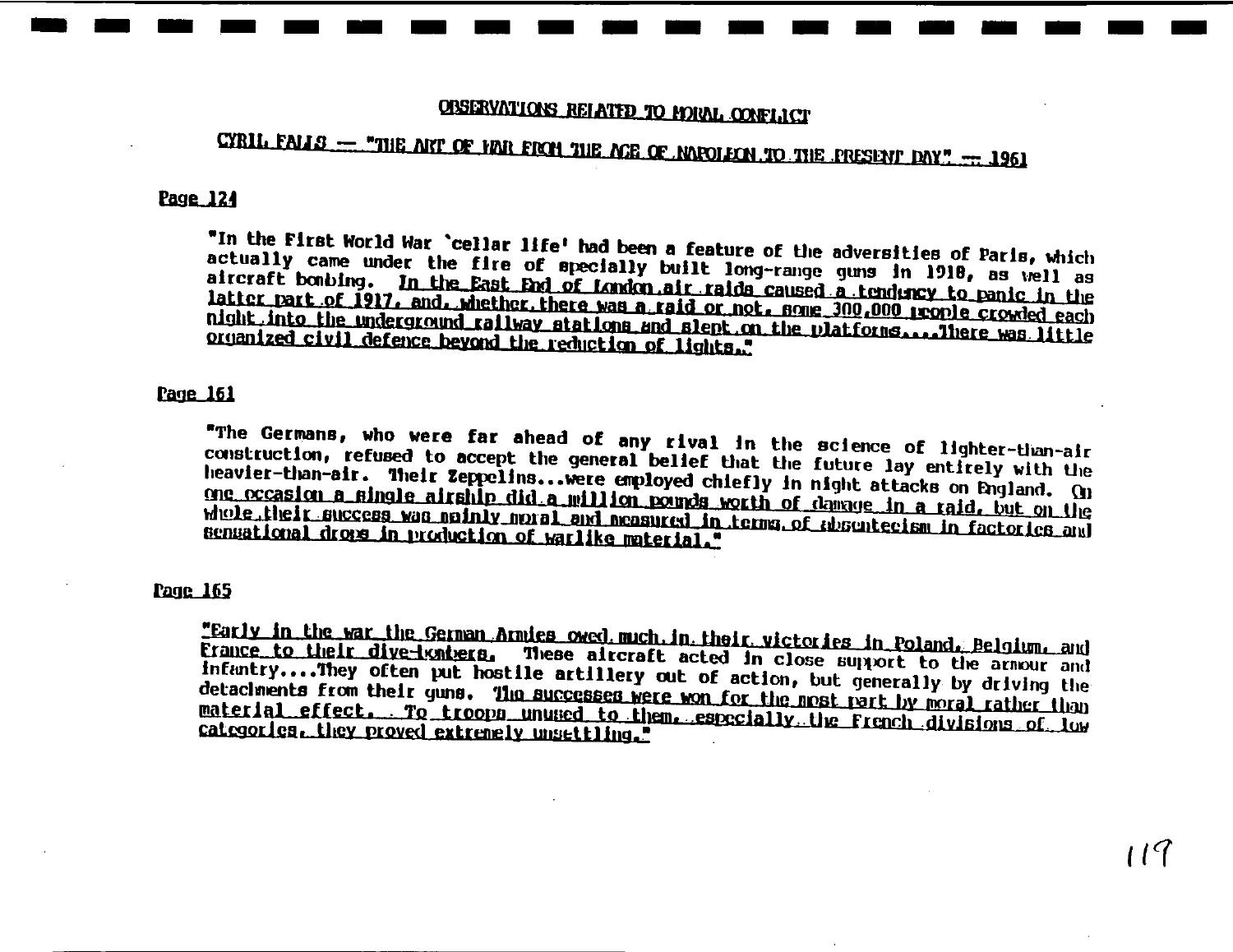
Cyril Falls, The Art of War from The Age of Napoleon to The Present Day (1961)
In the First World War ‘cellar life’ had been a feature of the adversities of Paris, which actually came under the fire of specially built long-range guns in 1918, as well as aircraft bombing. In the East End of London air raids cause a tendency to panic in the latter part of 1917, and, whether there was a raid or not, some 300,000 people crowded each night into the underground railway stations and slept on the platforms … There was little organized civil defence beyond the reduction of lights.
The Germans, who were far ahead of any rival in the science of lighter-than-air construction, refused to accept the general belief that the future lay entirely with the heavier-than-air. Their Zeppelins … were employed chiefly in night attacks on England. On one occasion a single airship did a million pounds worth of damage in a raid, but on the whole their success was mainly moral and measured in terms of absenteeism in factories and sensational drops in production of warlike material.
Early in the war the German Armies owed much in their victories in Poland, Belgium, and France to their dive-bombers. These aircraft acted in close support to the armour and infantry … They often put hostile artillery out of action, but generally by driving the detachments from their guns. The successes were won for the most part by moral rather than material effect. To troops unused to them, especially the French division of low categories, they proved extremely unsettling.
Revised slides · PDF p.121 · 1986 slides · PDF p.122 · Compare slides
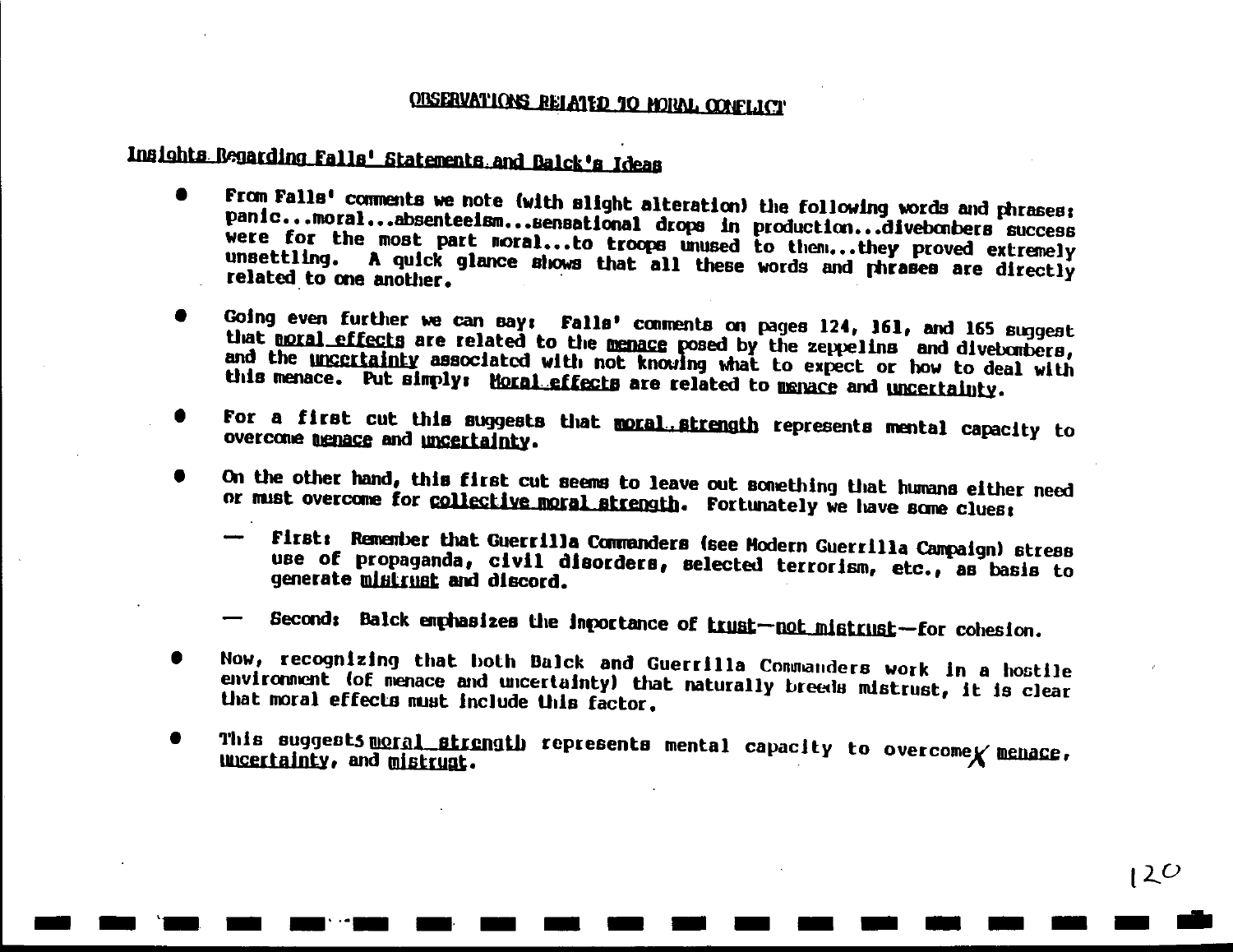
• From Falls’ comments we note (with slight alteration) the following words and phrases: “panic … moral … absenteeism … sensational drops in production … dive bombers’ success were for the most part moral ... to troops unused to them … they proved extremely unsettling.” A quick glance shows that all these words and phrases are directly related to one another.
• Going even further we can say: Falls’ comments on pages 124, 161, and 165 suggest that moral effects are related to the menace posed by the Zeppelins and dive bombers, and the uncertainty associated with not knowing what to expect or how to deal with this menace. Put simply: Moral effects are related to menace and uncertainty.
• For a first cut this suggests that moral strength represents mental capacity to overcome menace and uncertainty.
• On the other hand, this first cut seems to leave out something that humans either need or must overcome for collective moral strength. Fortunately we have some clues:
– First: Remember that guerrilla commanders (see Modern Guerrilla Campaign) stress use of propaganda, civil disorders, selected terrorism, etc., as basis to generate mistrust and discord.
– Second: Balck emphasizes the importance of trust—not mistrust—for cohesion.
• Now, recognizing that both Balck and guerrilla commanders work in a hostile environment (of menace and uncertainty) that naturally breeds mistrust, it is clear that moral effects must include this factor.
• This suggest moral strength represents mental capacity to overcome menace, uncertainty, and mistrust.
Revised slides · PDF p.122 · 1986 slides · PDF p.123 · Compare slides
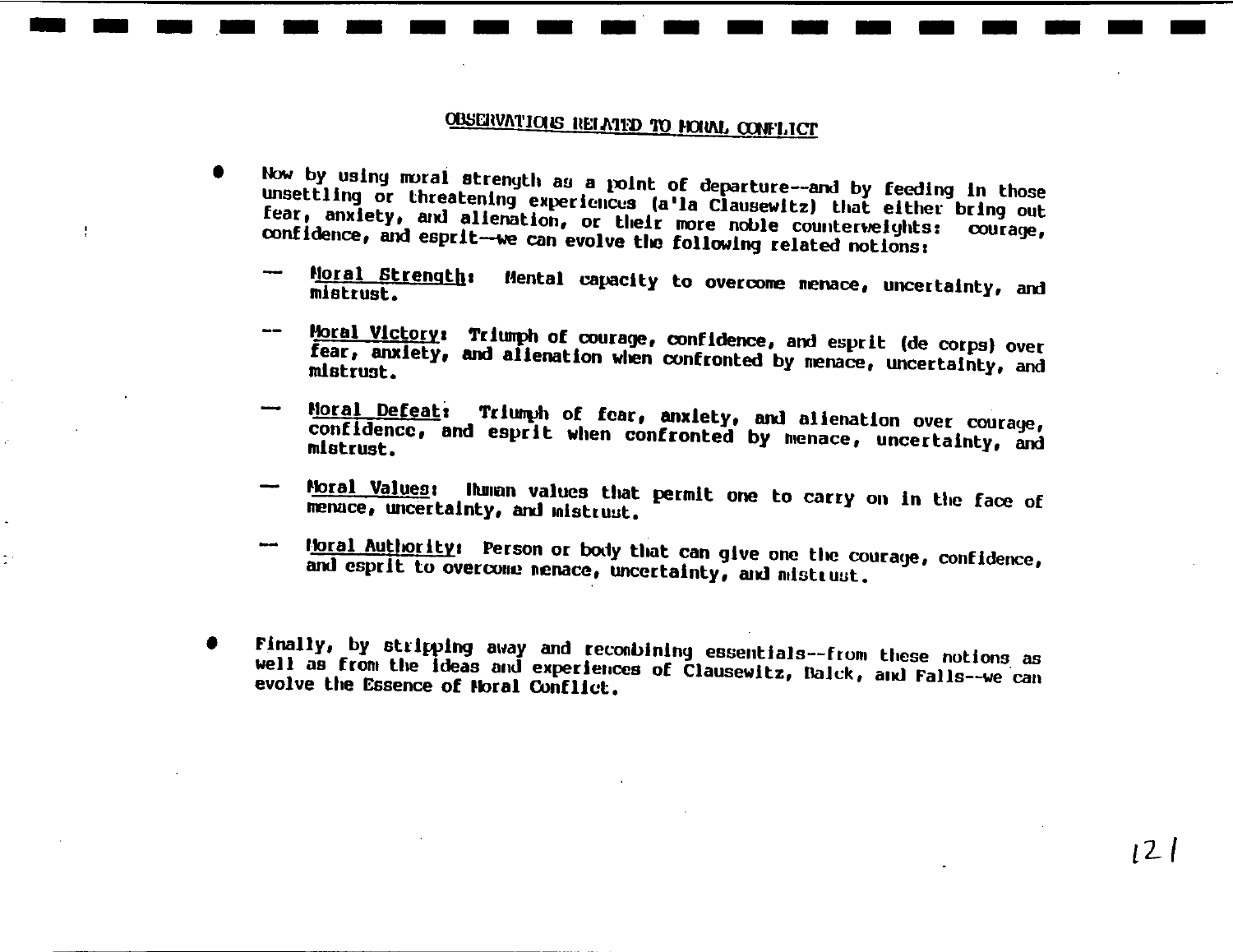
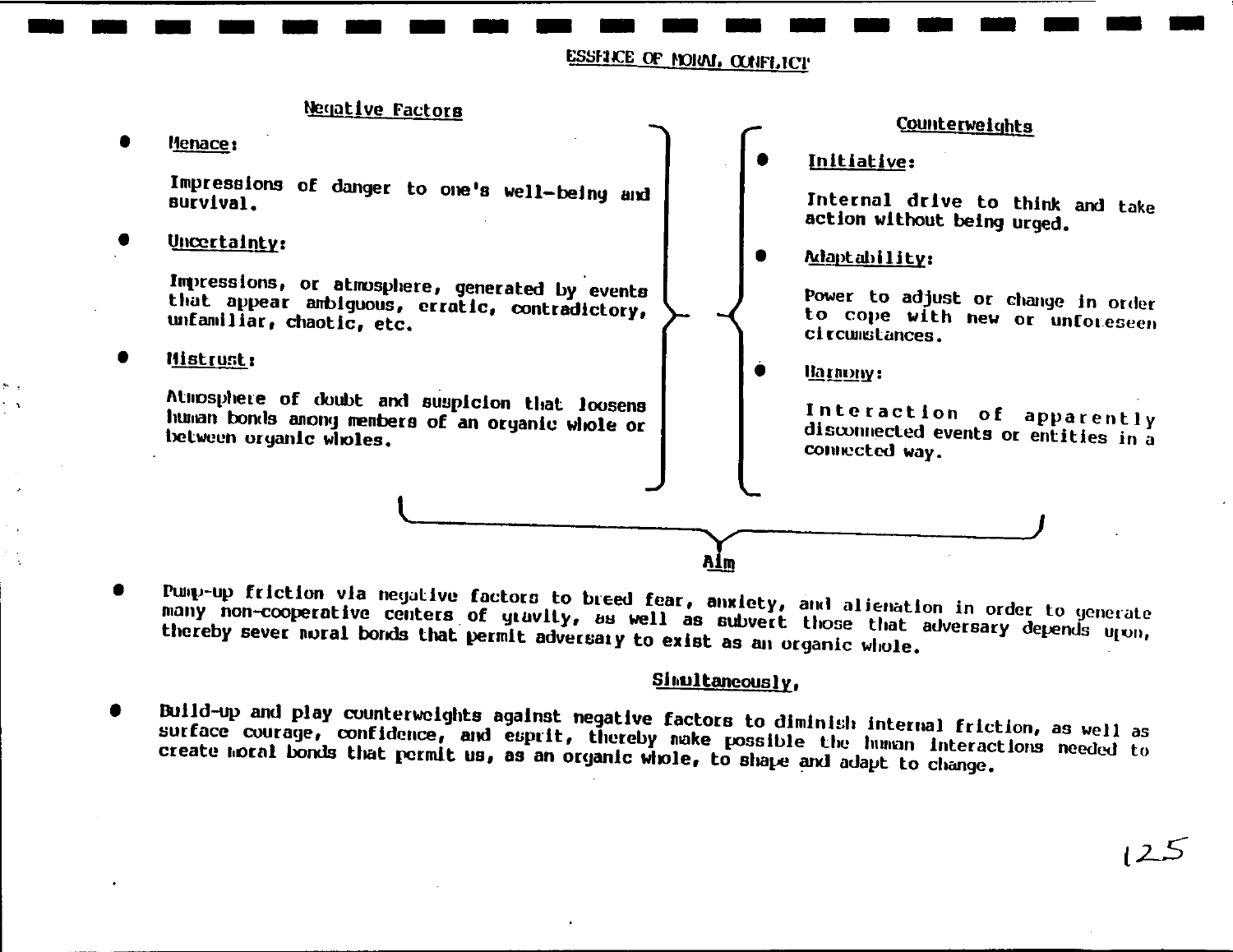
• Now by using moral strength as a point of departure—and by feeding in those unsettling or threatening experiences (a la Clausewitz) that either bring out fear, anxiety, and alienation, or their more noble counterweights: courage, confidence, and esprit—we can evolve the following related notions:
– Moral strength: Mental capacity to overcome menace, uncertainty, and mistrust.
– Moral victory: Triumph of courage, confidence, and esprit (de corps) over fear, anxiety, and alienation when confronted by menace, uncertainty, and mistrust.
– Moral defeat: Triumph of fear, anxiety, and alienation over courage, confidence, and esprit when confronted by menace, uncertainty, and mistrust.
– Moral values: Human values that permit one to carry on in the face of menace, uncertainty, and mistrust.
– Moral authority: Person or body that can give one the courage, confidence, and esprit to overcome menace, uncertainty, and mistrust.
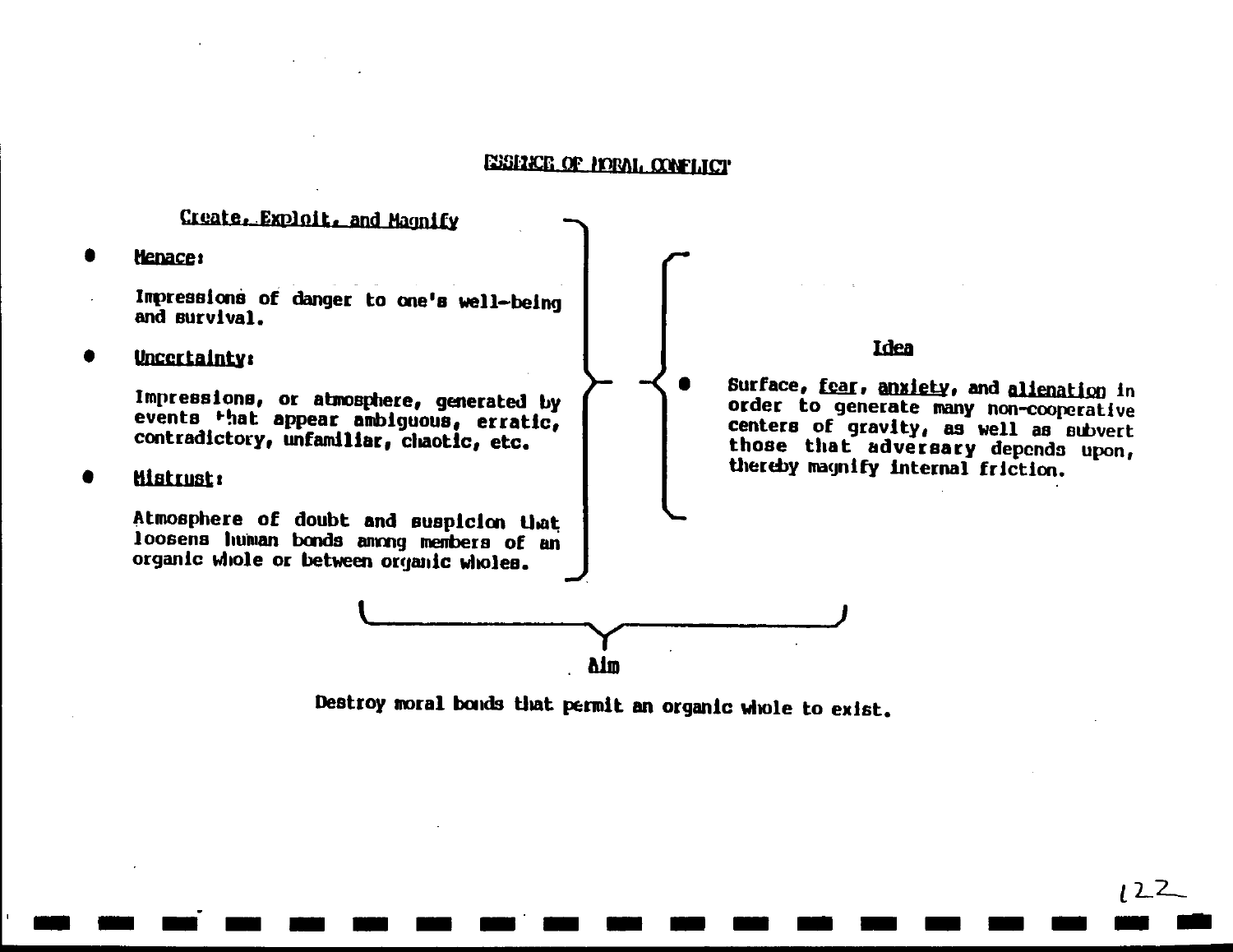
• Finally, by stripping away and recombining essentials—from these notions as well as from the ideas and experiences of Clausewitz, Balck, and Falls—we can evolve the essence of moral conflict.
Revised slides · PDF p.123 · 1986 slides · PDF p.124 · Compare slides
Revised slides · PDF p.124 · 1986 slides · PDF p.125 · Compare slides
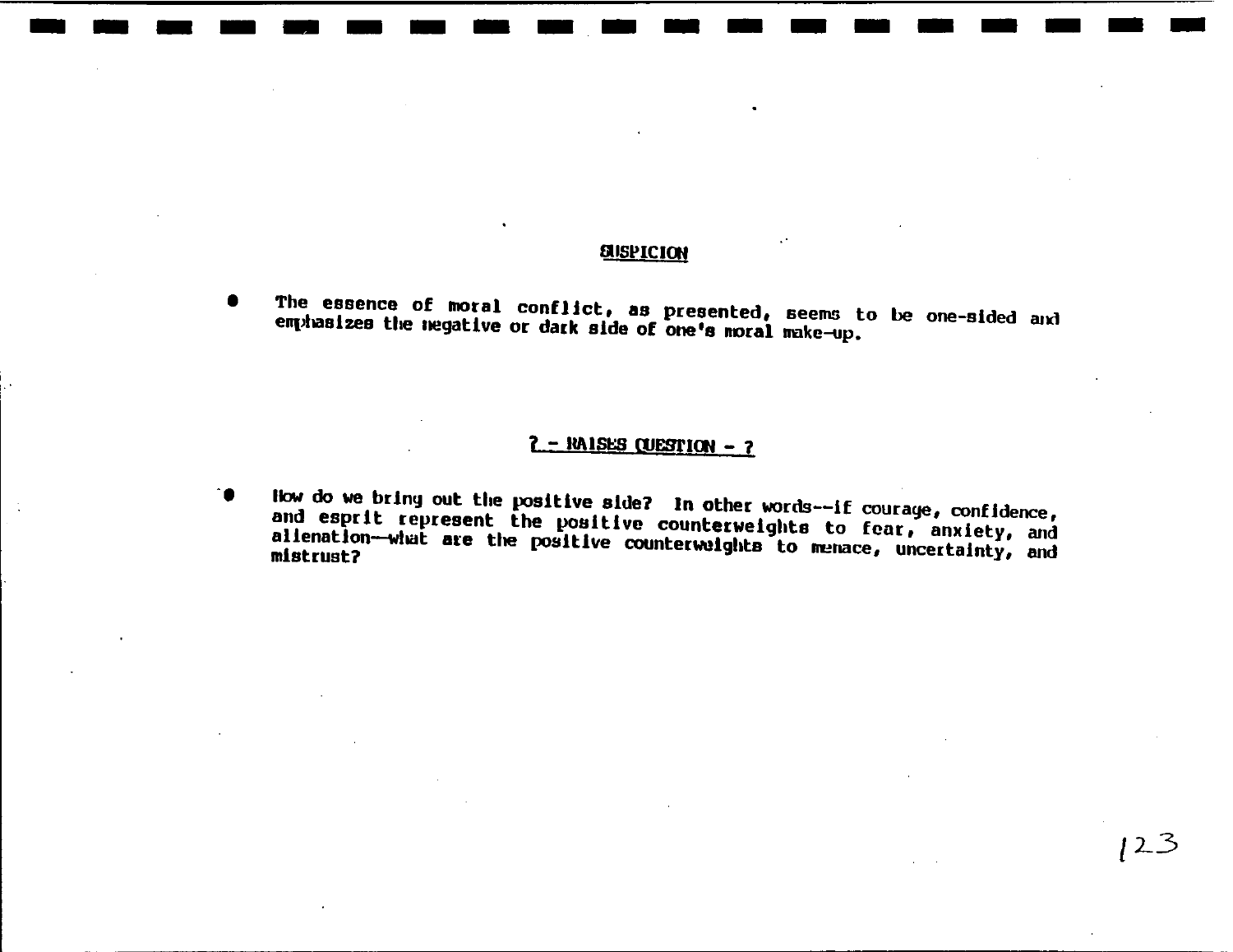
• The essence of moral conflict, as presented, seems to be one-sided and emphasizes the negative or dark side of one’s moral make-up.
• How do we bring out the positive side? In other words—if courage, confidence, and esprit represent the positive counterweights to fear, anxiety, and alienation—what are the positive counterweights to menace, uncertainty, and mistrust?
Revised slides · PDF p.125 · 1986 slides · PDF p.126 · Compare slides
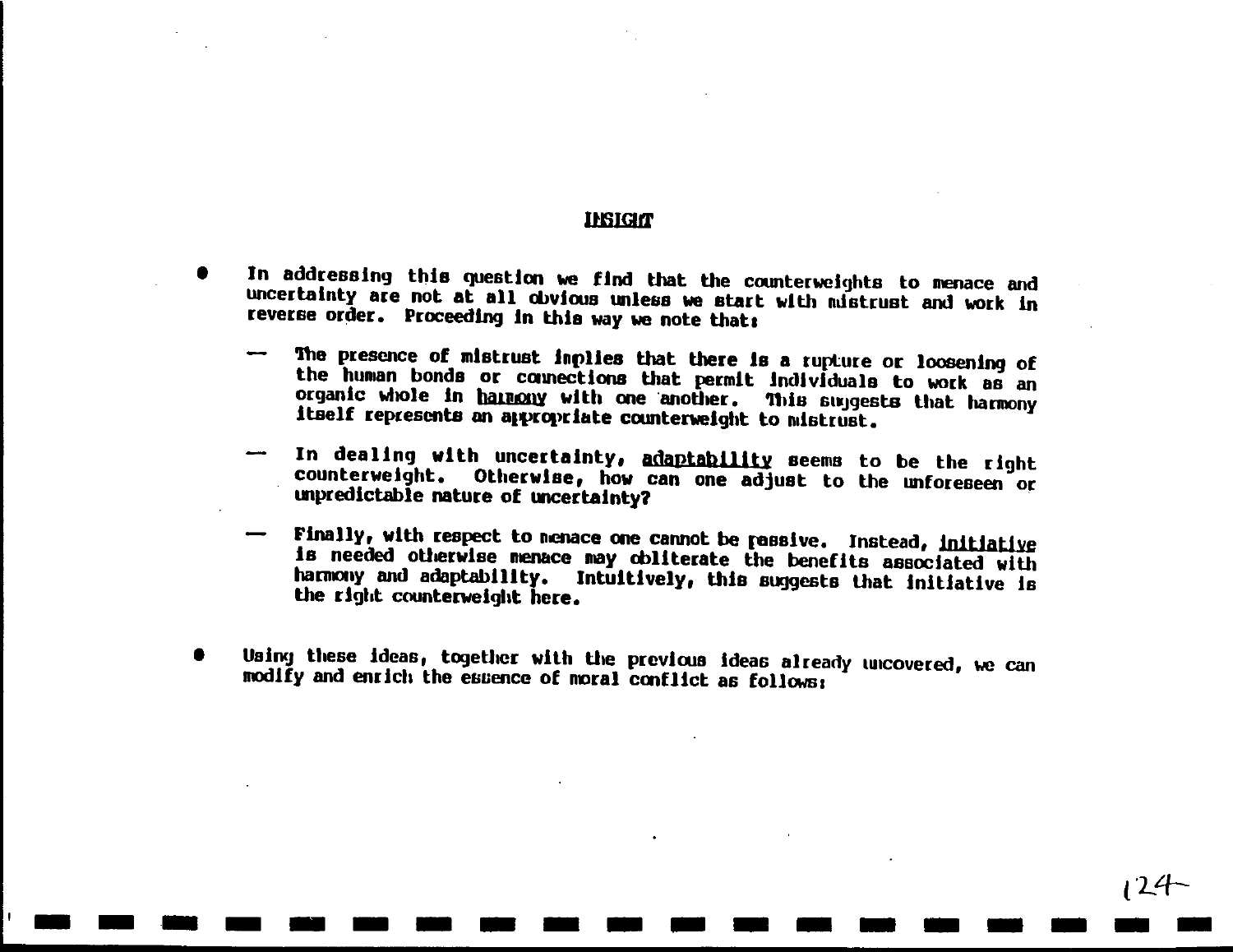
• In addressing this question we find that the counterweights to menace and uncertainty are not at all obvious unless we start with mistrust and work in reverse order. Proceeding in this way we note that:
– The presence of mistrust implies that there is a rupture or loosening of the human bonds or connections that permit individuals to work as an organic whole in harmony with one another. This suggests that harmony itself represents an appropriate counterweight to mistrust.
– In dealing with uncertainty, adaptability seems to be the right counterweight. Otherwise, how can one adjust to the unforeseen or unpredictable nature of uncertainty?
– Finally, with respect to menace one cannot be passive. Instead, initiative is needed. Otherwise, menace may obliterate the benefits associated with harmony and adaptability. Intuitively, this suggests that initiative is the right counterweight here.
• Using these ideas, together with the previous ideas already uncovered, we can modify and enrich the essence of moral conflict as follows:
Revised slides · PDF p.126 · 1986 slides · PDF p.127 · Compare slides
Revised slides · PDF p.127 · 1986 slides · PDF p.128 · Compare slides

Revised slides · PDF p.128 · 1986 slides · PDF p.129 · Compare slides
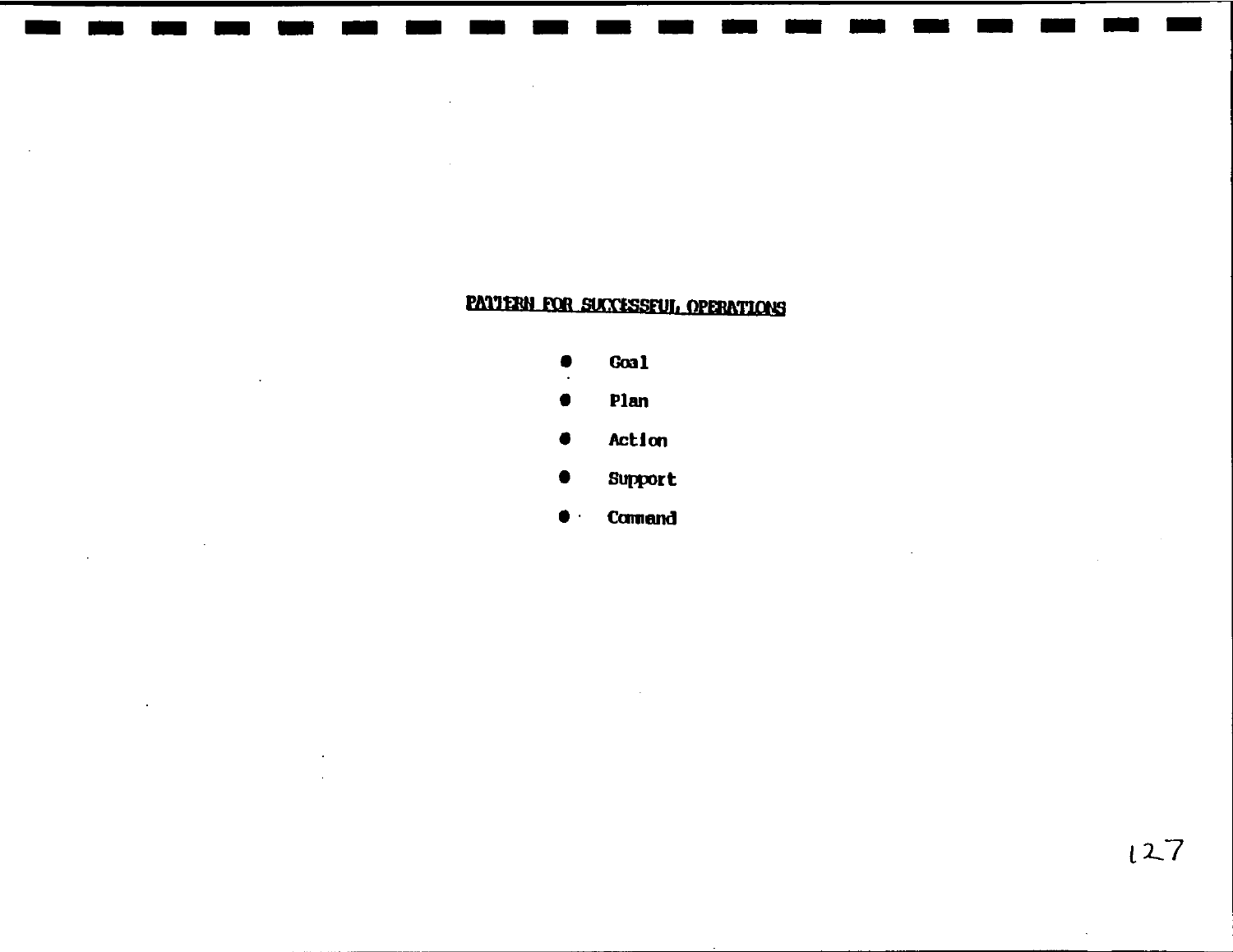
• Goal
• Plan
• Action
• Support
• Command
Revised slides · PDF p.129 · 1986 slides · PDF p.130 · Compare slides
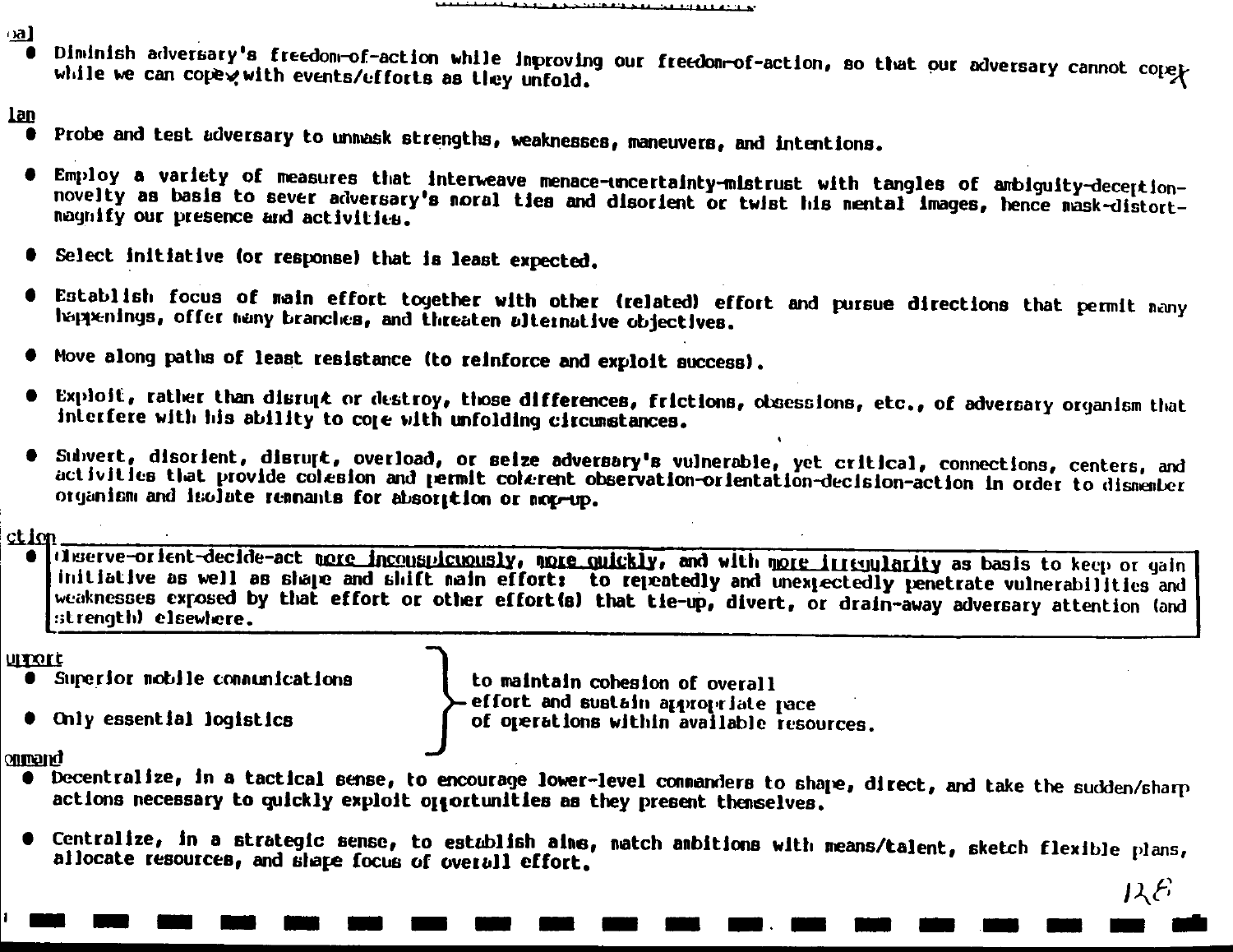
• Diminish adversary’s freedom of action while improving our freedom of action, so that our adversary cannot cope—while we can cope—with events/ efforts as they unfold.
• Probe and test adversary to unmask strengths, weaknesses, maneuvers, and intentions.
• Employ a variety of measures that interweave menace-uncertainty-mistrust with tangles of ambiguity-deception-novelty as basis to sever adversary’s moral ties and disorient or twist his mental images, hence mask-distort-magnify our presence and activities.
• Select initiative (or response) that is least expected.
• Establish focus of main effort together with other (related) effort and pursue directions that permit many happenings, offer many branches, and threaten alternative objectives.
• Move along paths of least resistance (to reinforce and exploit success).
• Exploit, rather than disrupt or destroy, those differences, frictions, obsessions, etc., of adversary organism that interfere with his ability to cope with unfolding circumstances.
• Subvert, disorient, disrupt, overload, or seize adversary’s vulnerable, yet critical, connections, centers, and activities that provide cohesion and permit coherent observation-orientation-decision-action in order to dismember organism and isolate remnants for absorption or mop-up.
• Observe-orient-decide-act more inconspicuously, more quickly, and with more irregularity as basis to keep or gain initiative as well as shape and shift main effort to repeatedly and unexpectedly penetrate vulnerabilities and weaknesses exposed by that effort or other effort(s) that tie up, divert, or drain away adversary attention (and strength) elsewhere.
• Decentralize, in a tactical sense, to encourage lower-level commanders to shape, direct, and take the sudden/sharp actions necessary to quickly exploit opportunities as they present themselves.
• Centralize, in a strategic sense, to establish aims, match ambitions with means/talent, sketch flexible plans, allocate resources, and shape focus of overall effort.
Revised slides · PDF p.130 · 1986 slides · PDF p.131 · Compare slides
• Plan and action statements suggest that we are trying to:
– Penetrate adversary system and mask own system against his penetration;
– Create a variety of impressions of what is occurring and what is about to occur;
– Generate mismatches between what seems to be and what is;
– Push adversary beyond his ability to adapt.
• Intentions that make-up plan cannot happen without application of transients that make-up action.